
Don’t give up hope on Failed Hypospadias

This is an interesting and inspiring story and I thought I will share it with everyone who has an interest in the field of hypospadias.

About 6 months back, a 14 years old boy was brought all the way from Nasik to my Pediatric Urology clinic at MITR Hospital in kharghar, Navi Mumbai. The parents did not seem to very well educated and were from a farming background. The father was in some class 4 government job. I was wondering why they would travel for 8 hours to a small place like kharghar to see me. Also the age seemed to me a little bit older than the usual age which I see in my clinic. I was intrigued.

The boy seemed little uncomfortable and had furtive glances here and there. Parents and relatives were fidgety too. The consultation began – I asked what brought them to Kharghar. They said that their kid has hypospadias and has undergone 5 surgeries till now but still passes urine from below. I asked them “how did they find me”. They said maternal uncle of the boy knows internet and found me while looking for information about hypospadias. So there it was Internet the great enabler at play.

I went through the case records dating 10 years back. The kid was born with scrotal hypospadias and underwent first major surgery at 2 years of age to straighten the penis (chordee correction) at a top medical college at Mumbai. Post that there were multiple attempts to make a new passage initially using native penile skin and then lining of urinary bladder twice and finally skin graft. Everything had failed and the last surgery was about 5 years back when it was told that there is no hope of the boy having a normal urethral opening at tip of penis. Now I knew the reason of furtive glances and fidgety mannerisms.

On examination, the boy had the urinary opening right near the anus, the penis was still slightly bent (chordee) and there was lots of scarring on underside of penis with deep pits and ragged skin edges. Further there seemed to be a couple of blind passages and left testis also looked higher in position, may be it was caught up in the scar process. Since the opening was even behind the scrotum, the child had to sit in the toilet and pass urine. Overall, the case seemed like mother of all hypospadias.

I counseled the parents and set out a planned staged correction of hypospadias. I told them it will be tough and they will need to be patient and have faith.  The plan was to bring him back to his original anatomy first and the reconstruct the entire new urinary passage. As the first stage, I planned to remove all the scarred skin and straighten the penis. In the raw area thus created I was planning to put buccal mucosa graft which is nothing but the inner layer of skin inside the mouth more specifically lips and cheeks. This buccal mucosa graft takes about 3-4 months to heal and then we planned to use this patch to create a new urinary passage. This would give a sure result and the buccal mucosa graft being moist and soft would not have any issues being in touch with urine. Also there would be no hair growth inside the passage in the future.

Well, the parents were convinced because probably I was the first hypospadias surgeon to offer them any hope. So we all set out on our task, an uphill journey.

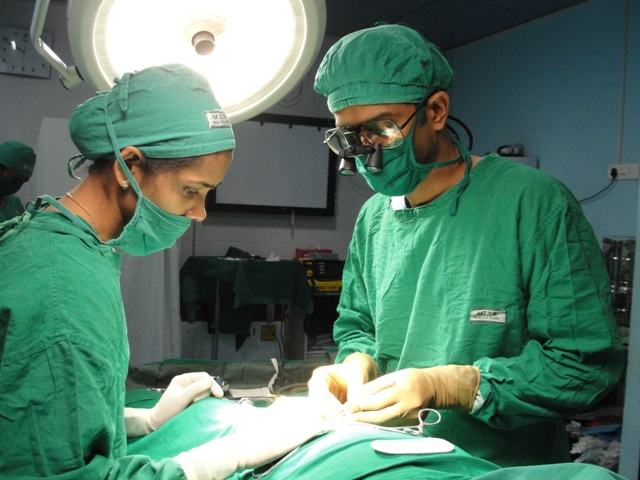
We took up VW for first stage surgery – expecting about 4 hours of surgical time. But we ended up consuming about 7 hours by doing the following

  • Cystoscopy and ascertaining usable urethral passage
  • Excision of all scar tissue on underside of penis
  • Straightening the penis – chordee correction
  • Closing the perineal urethrostomy and establishing a penoscrotal meatus.
  • Correcting the penoscrotal transposition
  • Left orchioexy was needed as the left testis was caught in the fibrosis
  • Buccal mucosa graft

But we were satisfied at the end of it all. We could not think of a shortcut as the child had been through a lot. The child remained in the hospital for 7 days and the graft healed very well. At removal of catheter, he was able to pass urine from the penoscrotal meatus without difficulty and was finally able to stand up and pass urine without wetting his pants. I could see the change in his behavior and he seemed more interactive now with me and the hospital staff. We had moved forward by an inch I guess!

4 months later we admitted him again for second stage urethroplasty. The previous graft had healed very well. We could easily make a new urethra just rolling the previous graft plate. This was done over a 12 French silicone catheter without any stress. To ensure full healing we also used a tunica vaginalis graft from the right testis to cover up the suture line.

As I write, the child has finished one month follow-up after urethroplasty surgery and is recovering well from the surgery. He is passing urine currently from the tip meaning the repair is holding well. The final result is yet to be seen and may be another minor procedure may be needed but the journey has been great. Our mood is upbeat and we are sure that we will reach the destination this time or another short journey may be needed 3 months from now. The fact of the matter is that we enjoyed the journey.

It is challenges like these when everyone else has given up, we still gear up and try to do our best for these kids. We may not pass in one attempt but eventually we will. Even if 20% need another surgery that is still acceptable as the final goal can still be achieved.

Contact Form for Hypospadias Foundation

Please fill all clinical details and upload pictures and clinical summaries (if available)
    Attach Documents (pdf | jpeg | mp4)
    (upload size upto 5mb)

    Should a distal hypospadias be repaired!!

    I did not know what was in store for me – there was 6 new patients in clinic and only 4 follow-ups and by the nature of it new patients take more time and follow-ups finish very fast. Anyway, the first patient who walked in was a 3 year old accompanied by young smart looking parents. The boy flashed a big smile and I said hello and he was eager to shake hands. That was a positive sign – Acceptance of me as a friend. Good so far.It was a nice Saturday evening, the watch clicked 7pm and I was in my Pediatric Urology clinic at Vashi with the last 10 urology appointments and was slated to be back home by 8pm.

    Invariably on Saturdays I get late but today I was all energized to finish consultations fast and head back home for a quiet dinner and then catch up on much neglected sleep.

    Then we got down to the business of consultation- the parents had looked up about hypospadias on internet and had found me and then travelled all the way to Navi Mumbai on a Saturday evening for a consultation for their little one who had hypospadias. I examined the eager and cooperative kid- he has a coronal hypospadias with mild tilt of glans (the head of penis). There was no chordee (actual bend of the body of penis) and testes were in normal location. Overall, it looked like a milder distal hypospadias which should be fairly easy to repair with a predictably good result.

    I explained everything about hypospadias – how it happens and how it is repaired and then the QA began. The parents asked – “Is it necessary to repair it? We have heard that it can lead to long term urinary problems and sexual dysfunctions as sometimes the nerves get cut during sensation leading to a numb penis. Also, there are blogs which talk about no need to do surgery in distal hypospadias as there may be long term complications like hair growth, tight passage, fistulas etc.” They had visited an eminent Urologist who had advised against surgery.

    Well, they had done their due research and it was good but sometimes the truth out there may not be whole truth. I had to counsel them and make sure that they know the whole truth while at the same time sounding detached from the whole process. It was after all their kid and their responsibility- my job was to give full, fair and medically sound information and then their job was to make the right decision for their kid.

    So here are the facts as I discussed with them:

    1. As the boy grows and finally the penis size become adult like, the deformity becomes more and more obvious. The glans (penis head) which was tilted will look more and more abnormal.
    2. The prepuce will only be on the top of the head and not on the underside leading to an incomplete prepuce. It looks rather like the head of a cobra in adulthood
    3. The urinary opening will be on the underside of penis and the urine stream will always be downward instead of forward as in a normal child.
    4. The problems as stated above will be more cosmetic than functional but they affect the psyche as he will be able to see that the shape and configuration of his penis is quite different from that of other children. This can lead to deep seated emotional and social withdrawal issues in teenage and adulthood.
    5. Repairs are easier with predictable and better results in childhood. Later on in teenage and adulthood repairs have higher failure rates and pain. Further erections can cause pain and instability in the repaired area after surgery.
    6. The blogs out there contain stories of people who underwent surgery for hypospadias in childhood and now are adults. Thus the care which they received was 20-25 years back. The art & science of Hypospadiology has moved at much faster pace in last two decades and now- the understanding of anatomy of penis & hypospadias is much better, the surgical techniques have evolved and most of the repairs are done in single stage, new instruments for finer surgeries are available, new fine absorbable & non-reactive stitches are available and above all there are doctors who are well trained in managing the children with hypospadias.
    7. Earlier surgeries using skin from scrotum or other body tissues are not done any more so currently any repair causing hair growth in urethra is outdated and not done by surgeons.
    8. Complications like fistula, tight passage (stricture) are less than 5% in experienced, trained surgeons hands for milder distal hypospadias.

    To sum up, it is worthwhile to repair distal hypospadias considering all the above. The science of hypospadias surgery has made sure that the children get the best results for surgery in their early childhood and then live their lives normal without worrying about their reproductive organs.

    Contact Form for Hypospadias Foundation

    Please fill all clinical details and upload pictures and clinical summaries (if available)

      Attach Documents (pdf | jpeg | mp4)
      (upload size upto 5mb)

      Hypospadias in Adults- Setting the right goals and expectations

      I get a lot of enquiries about hypospadias through our Hypospadias foundation website – Most of these are from concerned parents, sometimes  from relatives, sometimes from referring doctors but rarely from patients themselves. For writing about themselves, the patients have to be old enough to go on Internet and seek help. And with advancing awareness, these days most of the kids are referred to me in first few months of age and sometimes even in newborn age. So to get an inquiry from a patient happens only a couple of times in a month. And most of these are enquiries before an impending marriage!

      I was intrigued when I got an email from a VK 34 years old man wanting to consult me for hypospadias. My assistant, Akshay, explained to him about my consultation time at MGM vashi and at Mitr hospital.

      On Monday evening, VK wrote to me again saying that he went to MGM Vashi but they refused to make a file for him and sent him back with the explanation that Dr Singal treats only kids till 15 years of age. I felt really bad and I sent an email back to him and asked Akshay to schedule an out of turn consultation for the young man on Tuesday. Tuesday otherwise is usually my free day.

      So Tuesday evening, in walked VK, a smart confident young man. He was working as a senior software analyst in a well known consulting company and was married for last 3 years. The consultation began on a nice note. I went through all the papers dating back to one year of age. VK was born with a scrotal hypospadias and had undergone two stage repair at Wadia Hospital when he was 5 years of age, thereafter he had required a couple of minor procedures for narrowing of passage and urethral fistula but was mostly passing urine well. His main reason for consultation at this time was infertility. Secondary issue which we discussed was splaying of urine at time of passing urine. His urine came out in a form a spray rather than a well directed stream and he would often wet his pants and thus found it difficult to use a urinal for expeditious passing of urine.

      His sperm count was almost normal and he was able to have normal erections and ejaculations. The ejaculate was not forceful so an intrauterine insemination (IUI) had been tried but two sessions had failed.

      His secondary problem of a sprayed kind of urine stream was due to a wide open urinary meatus (hole) with a funnel kind of appearance and lot of loose skin folds around it. Also, the urinary opening was not at the tip of the penis but was rather on the underside about 3 cm from the tip.

      From a functional point of view, the location of the urinary opening was not in too bad a location to cause infertility.  Also, since IUI had failed, I was sure that the infertility problem was not due to hypospadias per se. Given the high incidence of primary infertility these days and advanced age of the mother (34 years), the infertility may have been because of some other factors.

      In his own mind, VK had thought that it was his hypospadias problem which was causing infertility. I spent close to 40 minutes trying to draw diagrams and explaining to him that we should look for other causes of infertility.  Finally, he was convinced and then I referred him to an infertility specialist and an andrologist. The plan was:

      • Re-evaluation of fertility status by checking all the reports of husband and wife again
      • Trial of In-vitro fertilization for having a child
      • And then repair of the hypospadias from urinary point of view once wife if pregnant.

      Both for the patient and the surgeon, it is very important to have the goals and expectations from any treatment set at the beginning of the treatment itself. VK had come to me with a primary issue of infertility and the secondary issue was urinary splaying due to incompletely repaired hypospadias. By solving his hypospadias issue, we could not have solved his infertility problem and I did not want him to have any false hopes and thus get surgery done for the wrong reason/ indication. Overall, VK was very happy with the plan. I hope that he will have a baby soon and then we will fix his rest of the urinary issues in a single stage and well.

      Over the last few years, our team – myself and Dr Manish Dubey have treated about 20 adults with various kinds of hypospadias and residual problems. Some of these have been for urethral fistulas, others for residual chordee or cosmetic issues. Most of these have come just before marriage or when they are facing issues such as VK. A couple of patients actually travelled from south India and one from Dubai to get treated.

      Contact Form for Hypospadias Foundation

      Please fill all clinical details and upload pictures and clinical summaries (if available)

        Attach Documents (pdf | jpeg | mp4)
        (upload size upto 5mb)

        Safe Surgery for Children with Hypospadias

        One of the important concerns for parents when their little ones are advised a surgery for hypospadias (urethroplasty), are risks associated with surgery. These concerns are true for a kid who is undergoing surgery for hypospadias as well. Safety is the foremost factor for parents while deciding a surgery for their kid.

        Same concern is valid for doctors (Pediatric Urologist, Anesthetist) and hospital team also. In some sense the safety checklist and precautions are important for any surgery which we plan to do in a child.

        The risks mainly stem from anesthesia which is needed for performing a surgery in a child. There are other risks associated with Hypospadias surgery itself but none of them are life threatening.

        To make surgery and anesthesia safe, the following precautions are undertaken:

        1. Pre-operative checkup for fitness: Blood and urine tests are done to make sure that the child is fit enough to undergo surgery and does not pose an increased risk of anesthesia. This also includes a thorough clinical examination to make sure that there is no infection lurking anywhere. In presence of any obvious infection such as cough, running nose, fever, diarrhea, skin infection etc it is better to postpone the surgery till the child recovers fully from infection. Infection leads to higher chances of infection at operated site and also slows down healing as body’s energy is spent in fighting the infection and thus healing takes a back seat.
        2. Sterile precautions: Instruments are properly sterilized the day before surgery and packed properly. The operation room is disinfected the evening before and locked. All sterile aseptic precautions are followed during scrubbing, draping etc.
        3. Availability of proper pediatric anesthesia equipments: Appropriate sized anesthesia equipment such as breathing tubes, masks, connectors, tapes, syringes, intravenous canula, intravenous infusion sets, needles, well calculated & checked anesthetic medicine doses etc are kept ready and labeled. Every single dose should be cross checked and labeled. Emergency medical equipment is cross checked before every single case and kept ready.
        4. Prevention of low body temperatures during surgery: Small children tend to lose a lot of body heat under cold environs of the operation theatre and thus get cold during surgery. The low body temperatures are called hypothermia. This can lead to multiple complications such as prolonged recovery from anesthesia, higher risk of infections and shivering. Hypothermia is best prevented – the steps taken are blanket to cover legs and upper body leaving only the lower tummy till mid thigh exposed for surgery, head cap and warm bandage rolls on arms and legs, electronic warming blanket underneath the baby set at 37-38 degrees, using warmed disinfectants, setting the AC temperatures to 25-26 degrees and not keeping them too low and then keep less operative area exposed and covering the rest of it with surgical drapes. For Hypospadias anyway a small area is exposed after preparing the middle part of the body with disinfectants.
        5. Dedicated Surgical equipment for kids: These include miniaturized microsurgery urethroplasty instruments, small retractors, small sutures (almost as fine as hair), fine clips, suction apparatus and smaller drapes. Larger instruments can crush the delicate tissues of kids and lead to poor surgical outcomes.
        6. Trained professionals: Doctors and nurses handling the kids undergoing surgery should be well trained in understanding that the kids are not small adults, their body behaves differently, the drug does should be perfect . The doses have lesser error margin and thus need to be calculated, cross checked and properly labeled. Putting an intravenous line requires training for handling kids and most importantly the Pediatric Urologist surgeon and the anesthetist should be very well trained in managing kids. Even a small excess of intravenous fluids during surgery can lead to major complications, that is the reason why pediatric infusion sets and connectors are very different from those in adults.
        7. Baby friendly environs of hospital: At MITR Hospital & Hypospadias foundation, we ensure that the kids are kept happy and engaged by the staff and the doctors during their hospital stay.

        Happy kids have a faster & better healing and this also decreases the complications of surgery.

        Contact Form for Hypospadias Foundation

        Please fill all clinical details and upload pictures and clinical summaries (if available)

          Attach Documents (pdf | jpeg | mp4)
          (upload size upto 5mb)

          Contact Us

          Call Now