
A 9-year-old female patient was brought to our clinic by her parents with concerns of an enlarged clitoris and dribbling of urine, prompting evaluation by her pediatrician. On examination, the pediatrician noticed enlarged clitoris with a single perineal opening. She was referred to a pediatric endocrinologist for further opinion and evaluation. Upon referral to a pediatric endocrinologist, laboratory tests identified elevated 17-hydroxyprogesterone (17-OHP) levels, alongside low cortisol and aldosterone levels, electrolyte levels were within normal limits thus confirming a diagnosis of simple virilizing congenital adrenal hyperplasia (CAH). The dribbling was due to vaginal pooling of urine during voiding.
The patient was initiated on steroid replacement therapy to correct hormonal imbalances by substituting deficient cortisol and suppressing excess androgen (male hormone) production.
Following stabilization, she was referred to the Hypospadias Foundation outpatient department for specialized pediatric urology evaluation and surgical planning. Clinical assessment at the pediatric urology clinic confirmed an enlarged clitoris with the clitoral length of 26 mm and a glans diameter of 10.5 mm, with a fused urethra and vaginal opening.
Comprehensive family counselling confirmed the child’s female gender identity and role, leading to the decision to proceed with feminizing genitoplasty — a reconstructive surgery aimed to restore anatomically and functionally appropriate female external genitalia.
Surgical Procedure
Under endoscopic guidance using a 4.5 Fr cystoscope, the common urogenital channel was inspected and measured to be less than 2.5 cm, with normal bladder anatomy and a visible cervix noted.
The surgical technique included Clitoroplasty, Vaginoplasty. Labioplasty:
Circumcoronal degloving and reduction of the enlarged clitoris while preserving neurovascular integrity
Separation and division of the urogenital sinus from the corporal bodies to allow proper anatomical reconstruction.
Removal of erectile tissue through precise incisions in the tunica albuginea
Reconstruction of a mucosa-lined vestibule by opening the dorsal wall of the urogenital sinus.
Creation of natural-appearing clitoral hood, mons pubis, labia minora, and labia majora
Click on the link to watch the feminizing genitoplasty video Single stage feminizing genitoplasty for CAH in a girl – YouTube
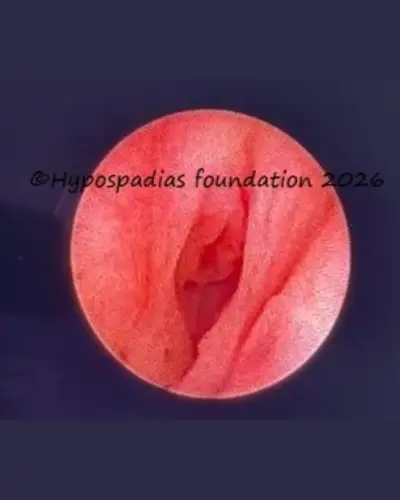
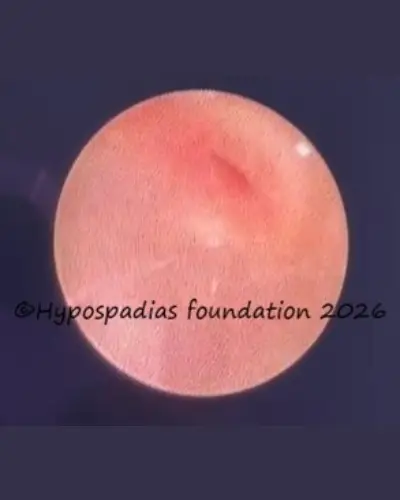
Pic 1: Genitoscopy showed vaginal opening and cervix
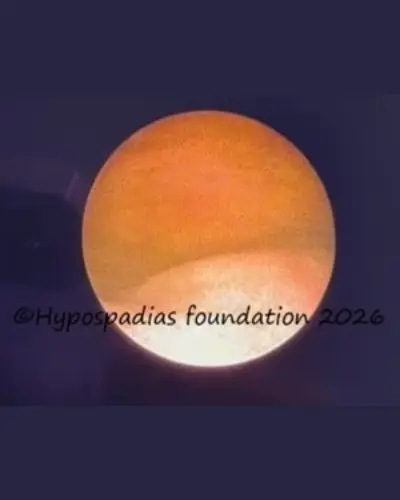
Pic 2: Cystoscopy showed normal bladder
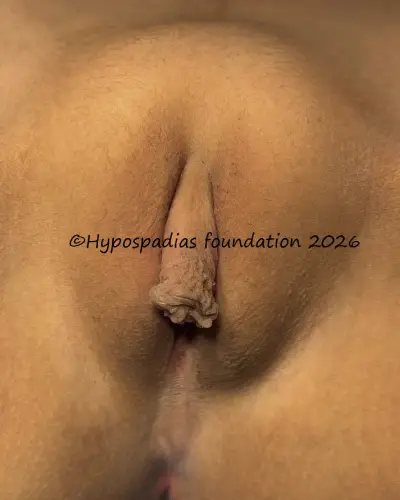
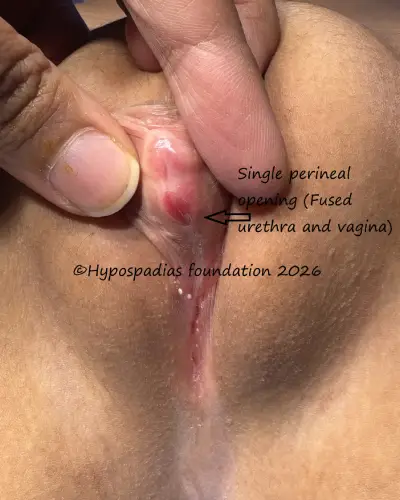
Pic 3: Pre surgery examination showed enlarged clitoris with single perineal opening
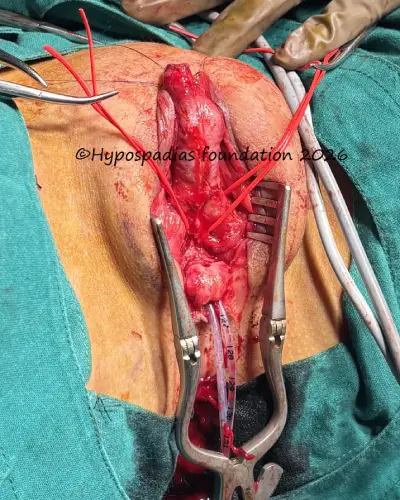
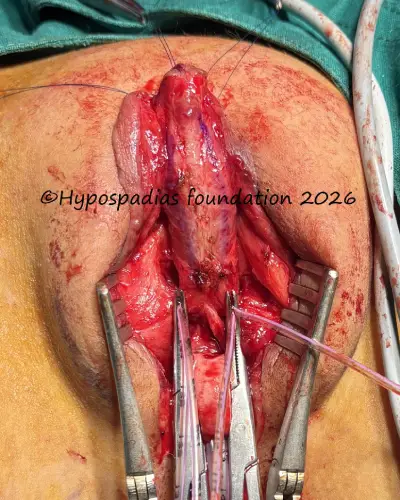
Pic 4: Clitoroplasty in progress: Complete degloving of the clitoris, division of urogenital sinus and isolation of corporal bodies. Second pic shows tourniquet application in both corporal bodies with vertical marking over the tunica for removal of erectile tissue pillars.
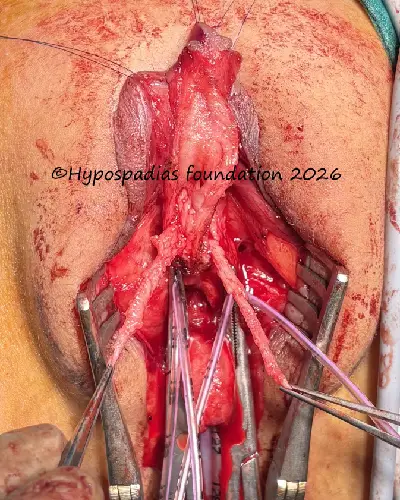
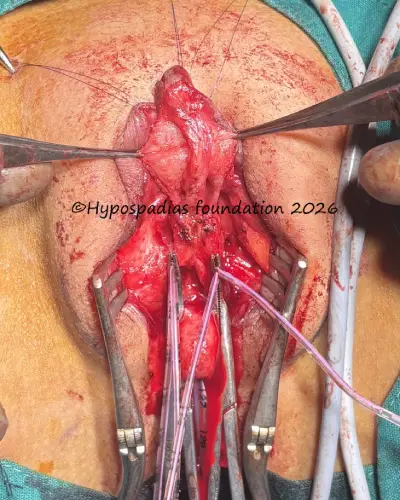
Pic 5: Erectile tissue pillars completely dissected, transfixed at the base and excised.
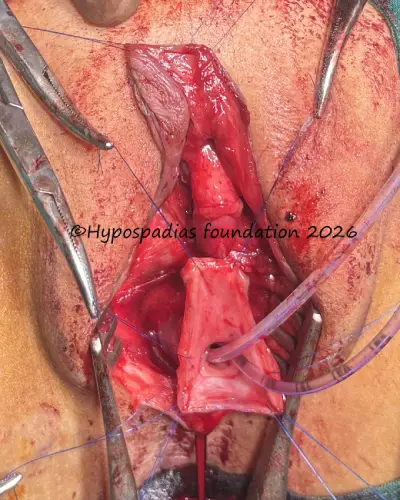
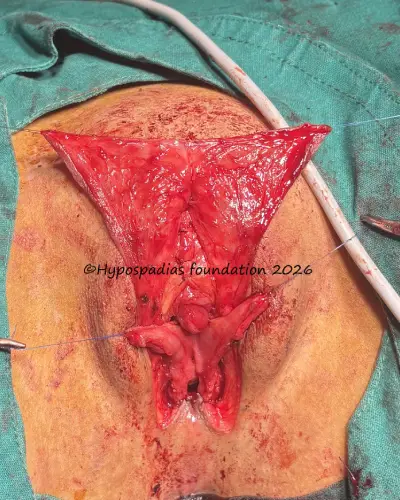
Pic 6: Ventral fixation of the clitoris done and stay suture taken all around the urogenital sinus. Urogenital sinus opened on the dorsal aspect till the vaginal opening.
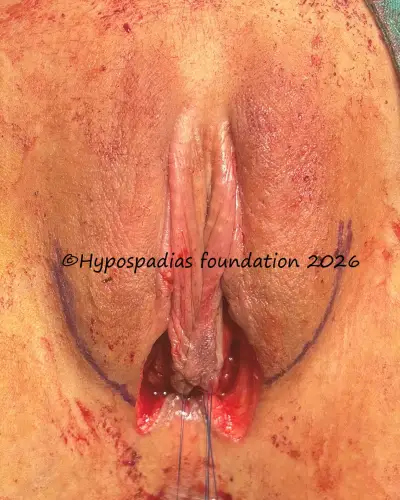
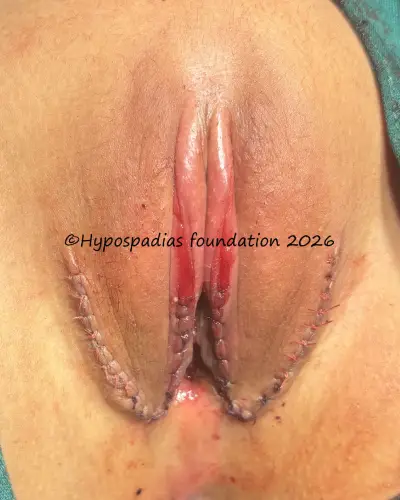
Pic 7: Labia majora flaps mobilized and advanced posteriorly
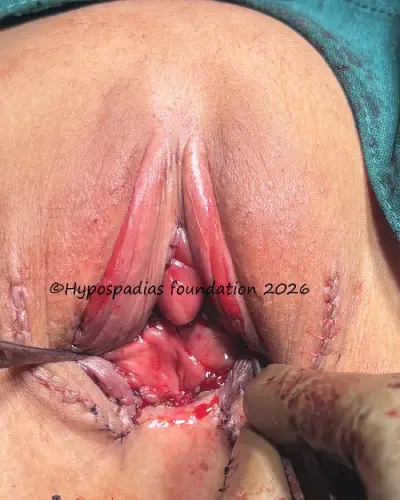
Pic 8: Completion of feminizing genitoplasty. Urethral and vaginal opening seenseparately
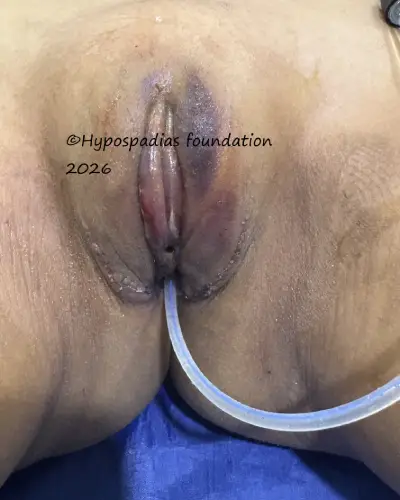
Pic 9: Appearance at day 4 after surgery
Postoperative Care and Outcome
A vaginal pack and pressure dressing were applied post-surgery. The vaginal pack was removed on postoperative day 3, and the per-urethral catheter was removed on day 7. The patient recovered well with no complications, demonstrating excellent cosmetic and functional results aligned with her gender identity.
Simple virilizing congenital adrenal hyperplasia (CAH) is an inherited disorder caused most commonly by a mutation in the CYP21A2 gene, resulting in 21- hydroxylase deficiency. It is inherited in an autosomal recessive manner.
CAH is broadly classified into classical and non-classical forms. Classical CAH is usually identified in infancy or early childhood, while non-classical CAH may presentlater in childhood, adolescence, or adulthood.
In simple virilizing CAH, reduced 21-hydroxylase activity impairs the adrenal glands' ability to produce adequate amounts of cortisol. As a result, the body responds by increasing stimulation of the adrenal glands, leading to adrenal enlargement and increased production of adrenal steroid precursors. These precursors are diverted toward androgen production, resulting in varying degrees of virilization.
Causes and Pathophysiology
The adrenal glands produce several important hormones, including cortisol, through a series of enzymatic steps that begin with cholesterol. 21-hydroxylase deficiency interferes with the normal pathway for cortisol synthesis.
When cortisol production is reduced, the pituitary gland increases secretion of ACTH (adrenocorticotropic hormone) in an attempt to stimulate the adrenal glands. Persistent ACTH stimulation causes adrenal cortical hyperplasia and increases the production of steroid precursors.
One of the most important precursors that accumulates is 17-hydroxyprogesterone (17-OHP). Markedly elevated 17-OHP levels are an important biochemical marker used in the diagnosis of 21-hydroxylase deficiency. The excess steroid precursors are also increasingly converted into androgens, leading to virilization.
Unlike the salt-wasting form of classical CAH, children with the simple virilizing form generally retain sufficient mineralocorticoid function and therefore typically do nothave significant salt loss or severe electrolyte abnormalities.
Clinical Presentation
The clinical features depend on the degree of androgen exposure and the childs sex chromosome complement.
In 46, XX infants, exposure to excess adrenal androgens before birth can result in varying degrees of virilization of the external genitalia. This may include:
Enlargement of the clitoris
Fusion of the labia
A partially or completely masculinized appearance of the external genitalia
A common urogenital sinus, depending on the degree of virilization
The internal female reproductive organs, including the uterus and ovaries, are generally present because CAH does not interfere with their development.
Children with the simple virilizing form generally do not present with the severe dehydration, hypotension, and electrolyte disturbances characteristic of salt-wasting CAH. However, appropriate hormonal evaluation is essential to establish the diagnosis and determine the precise form of CAH.
Diagnosis
Diagnosis involves a combination of clinical assessment, hormonal evaluation, and genetic and chromosomal testing when appropriate.
Important investigations may include:
Serum 17-hydroxyprogesterone (17-OHP)
Serum electrolytes and other adrenal hormones
Karyotyping or chromosomal analysis when sex assignment is uncertain
Genetic testing for CYP21A2 mutations in selected cases
When a newborn presents with ambiguous or significantly virilized genitalia,evaluation should be coordinated by a multidisciplinary team, which may include a pediatrician, pediatric endocrinologist, pediatric urologist, geneticist, and appropriately trained counsellors.
Treatment
The cornerstone of treatment is hormone replacement therapy, primarily with glucocorticoids. Glucocorticoid therapy replaces the body's deficient cortisol and reduces excessive ACTH stimulation of the adrenal glands. This, in turn, helps suppress the excessive production of adrenal androgens.
Children should be monitored regularly by a pediatric endocrinologist to assess growth, hormone levels, treatment response, and medication requirements.
In children with salt-wasting disease or mineralocorticoid deficiency, additional treatment may be required to maintain appropriate electrolyte and fluid balance. Although significant salt loss is not usually present in the simple virilizing form,electrolyte assessment remains an important part of the initial evaluation.
Gender Assignment and Counselling
Virilising CAH as the present case falls under a category of conditions called Disorders of Sex Development of DSD. A newborn with significantly virilized genitalia can present a challenging situation for parents and the medical team. Gender assignment should not be based solely on the appearance of the external genitalia.
In a child with suspected CAH, particularly when the genital appearance is atypical, appropriate evaluation should include hormonal investigations and chromosomal analysis to establish the diagnosis and determine the child's sex chromosome complement.
For 46XX children with CAH, female sex assignment is generally recommended. However, discussions surrounding sex assignment and long-term management should be handled carefully and sensitively, with appropriate counselling for the child and family.
Parents should be given adequate time and clear, balanced information about the diagnosis, treatment options, surgical considerations, and long-term follow-up. A multidisciplinary approach can help families make informed decisions while prioritizing the child's physical and psychological well-being.
Feminizing Genitoplasty
46 XX children with CAH may undergo feminizing genitoplasty to reconstruct the virilized external genitalia. The timing and extent of surgery should be individualized and discussed carefully with the family.
These procedures are technically delicate and should be performed by a surgeon experienced in pediatric genital reconstruction and CAH. Surgical planning requires a detailed understanding of the child's anatomy, including the location and anatomy of the vagina and urethra.
Inadequate surgical technique can result in complications such as scarring, narrowing of the vaginal opening (vaginal stenosis), urinary problems, or unsatisfactory cosmetic and functional outcomes. For this reason, surgery should be undertaken only after comprehensive evaluation, counselling, and careful multidisciplinary planning.
CAH & DSD Care at Hypospadias Foundation and Pediatric Urology
At Hypospadias Foundation and Pediatric Urology, we evaluate children presenting with a range of congenital genital and urological conditions, including congenital adrenal hyperplasia and disorders of sex development.
Children with CAH are evaluated in close coordination with a pediatric endocrinologist. Before considering any surgical procedure, our priority is to establish the diagnosis, optimize hormonal treatment, assess and correct any electrolyte abnormalities, and understand the child's anatomy and future fertility.
We believe that thorough counselling of the child and family is an essential part of care. Surgical intervention is planned only after appropriate medical optimization and after the family has had sufficient opportunity to understand the condition, available treatment options, expected outcomes, and potential risks.
Feminizing genitoplasty in CAH is a highly specialized procedure requiring experience, meticulous surgical technique, and individualized planning. Our approach is focused on providing comprehensive care while keeping the childs long- term health, function, well-being, and family needs at the centre of decision-making.
A Multidisciplinary Approach
Successful management of CAH often requires collaboration between:
Pediatric endocrinology
Pediatric urology
Genetics
Anesthesia and critical care, when required
Psychology and counselling services
This coordinated approach helps ensure that medical treatment, hormonal management, surgical planning, and family counselling are addressed together.
If your child has been diagnosed with CAH or has atypical or virilized genitalia, early evaluation by an experienced multidisciplinary team can help establish the diagnosis and guide appropriate treatment and long-term care.