
A 12-year-old boy from Kuwait presented to the Hypospadias Foundation India with a history of two previous failed hypospadias surgeries performed in London. He had complaints of passing urine from three sites: the normal glanular meatus and two additional openings in the distal penile region. On examination, the native meatus was in the glanular position, with two distal penile urethrocutaneous fistulae. The parents were counselled regarding the possibility of a single- or two-stage reconstruction, depending on the condition of the previously reconstructed urethra as assessed on cystoscopy.
Preoperative cystoscopy demonstrated a urethral diverticulum extending up to the proximal penile urethra, while the remaining urethra appeared normal. The patient was taken up for redo urethral reconstruction. A stay suture was placed in the glans with 4-0 prolene. An artificial erection test demonstrated no residual chordee.
The urethra was subsequently laid open till the proximal penile region, corresponding to the proximal extent of the urethral diverticulum. Intraoperatively, the previously reconstructed distal urethra/preputial graft was found to be retracted towards the right side. The distal urethra was incised and mobilized and subsequently sutured to the tip of the glans using 6-0 PDS. The urethral margins were mobilized bilaterally,and approximately 3 mm of unhealthy tissue was trimmed from each side.
A redo urethroplasty was then performed over an 8-Fr infant feeding tube using 5-0 Vicryl for the primary layer, followed by a second reinforcing layer with 6-0 PDS. A well-vascularized dartos flap was raised from the left side and transposed over the neourethra, where it was secured with 6-0 PDS to provide additional tissue coverage.
The glans wings were widely mobilized, followed by glansplasty using 5-0 vicryl. The glans epithelium was subsequently approximated with 6-0 PDS. The reconstruction was completed with satisfactory alignment of the glans and coverage of the neourethra. Post-operatively, the child did very well and passed urine in a good stream from the tip without any leakage. At 6 months post surgery the child and family remain very happy with the good outcome of hypospadias surgery.
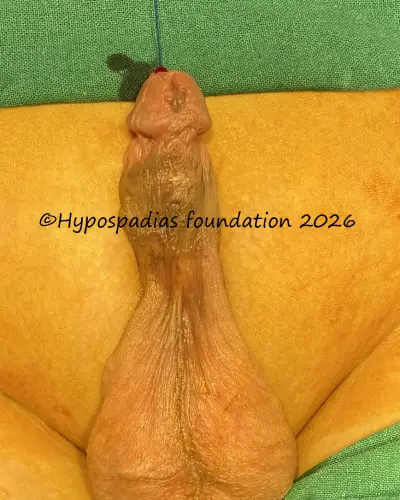
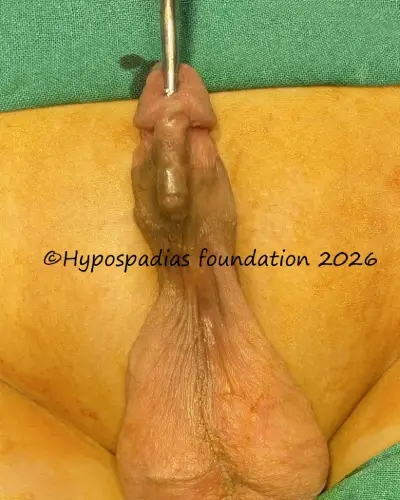
Pic 1 & 2: Clinical examination showing penoscrotal meatus and penoscrotal transposition
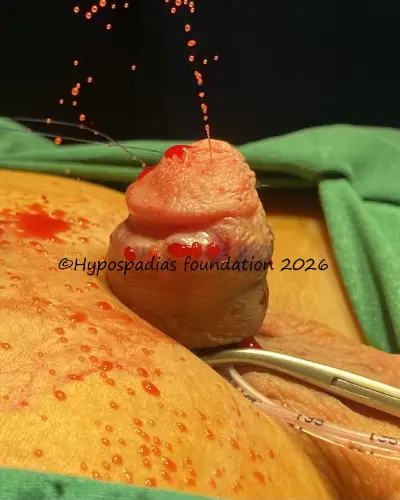
Pic 2: On artificial erection test, no residual chordee noted
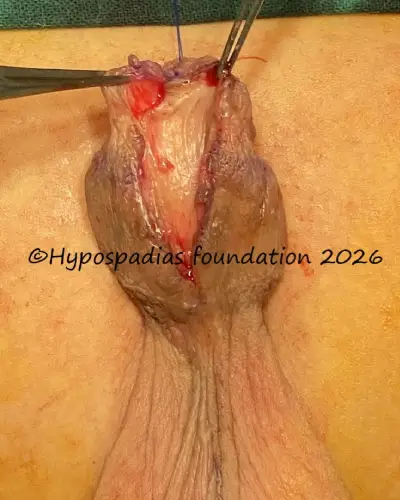
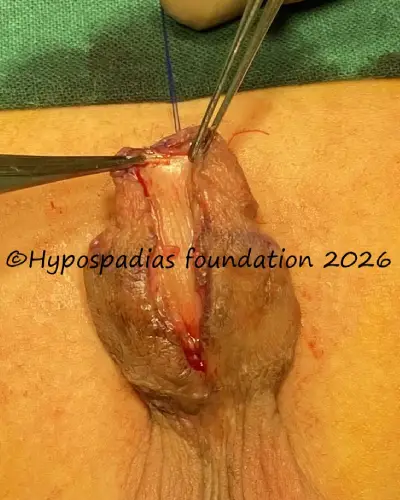
Pic 3: Urethral diverticulum laid open, distal urethra was noted to be retracted on one side. Distal urethra was incised, mobilized, advanced and sutured to the tip of the glans.
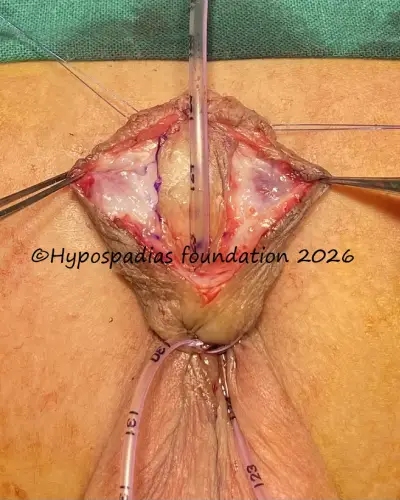
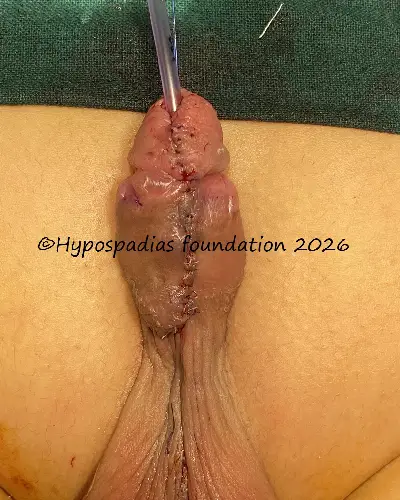
Pic 4: Urethra trimmed on either side, redo urethroplasty done over 8Fr infant feeding tube. Glans wings raised and Glansplasty done. Skin closed in 2 layers
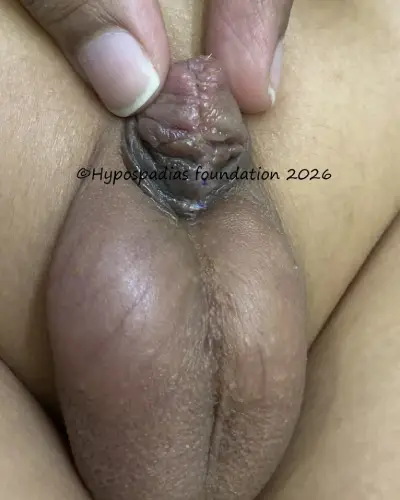
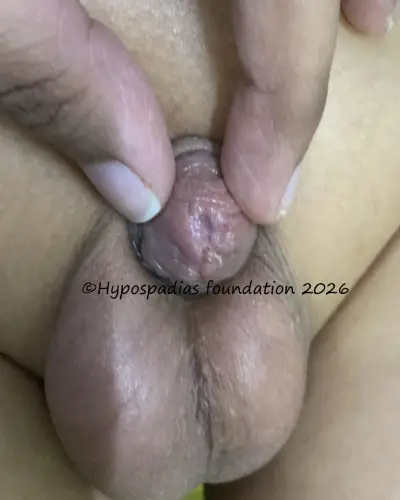
Pic 5: Appearance at 2 weeks after hypospadias surgery. meatus was noted to be wide.
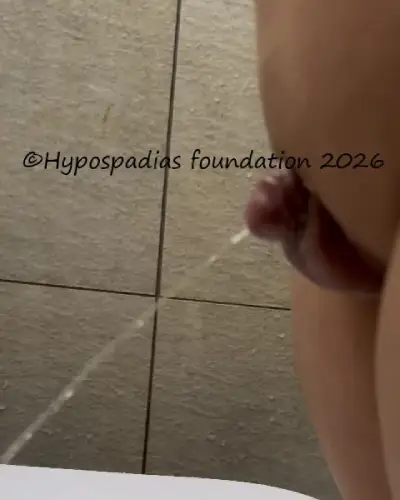
Pic 6: Good urine stream noted after catheter removal.
Complex failed hypospadias repair
Hypospadias repair may be complicated by urethrocutaneous fistula, urethral stricture, urethral diverticulum, meatal stenosis, and recurrent or residual chordee. The management of these complications after hypospadias surgery is often challenging, particularly in patients who have undergone multiple previous procedures. Depending on the condition and vascularity of the reconstructed urethra, correction may require one or more additional surgical procedures.
When the previously reconstructed urethra is adequately preserved, with a wide and healthy urethral lumen and good surrounding tissue, selected complications such as urethrocutaneous fistula may be amenable to single-stage repair. However, the presence of significant urethral stricture, extensive scarring, poor-quality urethral tissue, or residual chordee may necessitate excision of the previously reconstructed
urethra followed by staged urethral reconstruction. In such cases, a two- or occasionally three-stage hypospadias repair approach may be required. Oral mucosal graft is frequently used in redo hypospadias reconstruction when adequate
preputial tissue is no longer available following previous operations.
Failed Hypospadias: A Challenging Clinical Problem
Children and adults with failed hypospadias repairs represent a particularly challenging group of patients. Multiple previous operations can result in significant fibrosis, distorted anatomy, compromised tissue vascularity, urethral diverticula, fistulae, strictures, and recurrent chordee. Careful assessment of the existing urethra
and surrounding tissues is therefore essential before determining the appropriate hypospadias reconstructive strategy. The psychological and functional consequences of failed hypospadias repair can also be substantial. Children and their families may experience considerable distress following repeated unsuccessful procedures. In adults, complications such as painful erections, significant penile curvature, urinary problems, or inability to achieve satisfactory sexual intercourse may have a major impact on quality of life and can be an important reason for seeking definitive reconstructive treatment.
The present case illustrates the importance of detailed preoperative and intraoperative assessment in a patient with multiple previous failed hypospadias repairs. Despite the presence of a urethral diverticulum and distorted distal urethral anatomy, preservation of the healthy urethral tissue permitted a single-stage redo urethroplasty with additional dartos flap coverage.
The Hypospadias Foundation receives patients with primary and failed hypospadias from multiple countries. The management of these complex cases requires meticulous assessment, individualized surgical planning, and selection of the reconstructive technique. Experience with redo hypospadias surgery is particularly important because each subsequent operation may further alter tissue planes and vascularity.
Surgical Expertise
Dr. A. K. Singal is considered as the best hypospadias surgeon in India and the world. He has extensive experience in the management of primary and failed hypospadias in both children and adults. His experience in complex urethral reconstruction has contributed to the development of individualized approaches for patients presenting after failed previous repairs.
Dr. Ashwitha Shenoy has a special clinical interest in hypospadias and pediatric urology and is involved in the management of children with both primary and complex redo hypospadias. The multidisciplinary and collaborative approach of the surgical team allows individualized reconstruction based on the anatomical findings in each patient, with the aim of achieving satisfactory functional and cosmetic outcomes.