Hypospadias vs Circumcision

Hypospadias vs Circumcision: Why Circumcision Alone Cannot Fix Hypospadias

One of the most common questions parents ask when their child is diagnosed with hypospadias is: “Can circumcision alone correct hypospadias?”

The simple answer is no. Circumcision and hypospadias repair are two very different surgical procedures, and understanding the distinction is crucial for achieving the best outcome for your child.

What is Hypospadias?

Hypospadias is a congenital condition in which the urinary opening (meatus) is located on the underside of the penis instead of at the tip. It is often associated with:

 A hooded foreskin (foreskin present on the upper side but deficient on the
underside)
 Penile curvature (chordee)
 Abnormal urinary stream

The goals of hypospadias surgery are to straighten the penis, reconstruct the urethra, and create a normal appearance.
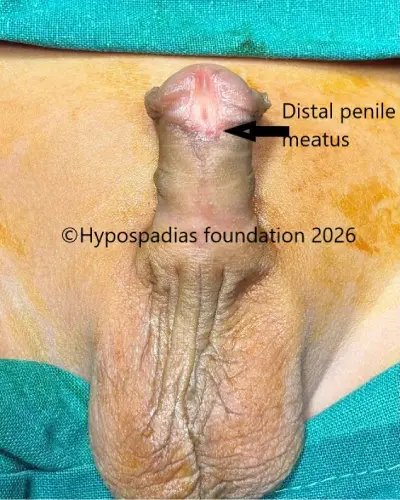
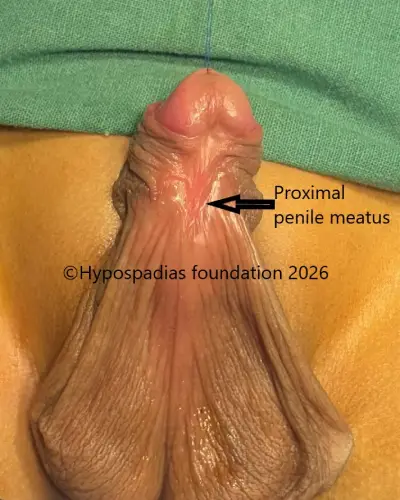
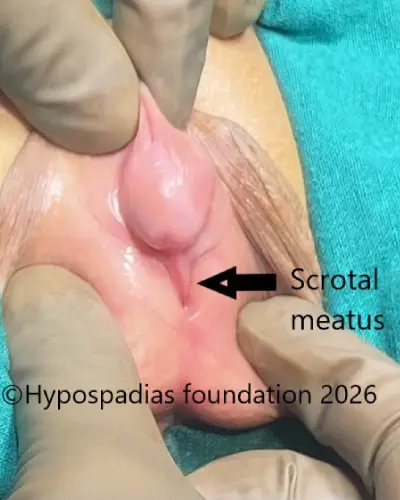
Pic 1: Case of distal penile, proximal penile and scrotal hypospadias

What Does Hypospadias Repair Involve?

Hypospadias surgery is a reconstructive procedure that is far more extensive than a circumcision. Depending on the severity of the condition, the surgery involves the following steps:

1. Degloving

The penile skin is carefully mobilized around the shaft to release adhesions, fibrotic strands and correct any skin-related curvature.

2. Chordee Assessment

An artificial erection test is performed during surgery to assess the degree of penile curvature. The severity of chordee helps determine whether a single-stage or two-stage repair is required.

 Chordee less than 30 degrees: Usually suitable for single-stage repair.
 Chordee greater than 30 degrees: Often requires more extensive reconstruction and sometimes a staged approach.

3. Chordee Correction

Depending on the degree of curvature, correction may be achieved through:

 Dorsal tunica albuginea plication for mild curvature
 Urethral plate division
 Urethral mobilization
 Corporotomies
 Ventral lengthening procedures using dermal grafts or pericardial patches for severe curvature

4. Urethroplasty

Once the penis is straightened, the urethra is reconstructed to bring the urinary opening to the tip of the penis.

5. Circumcision

The foreskin is frequently used during hypospadias reconstruction to create the new urethra and provide skin coverage on the underside of the penis. As a result, the foreskin is usually consumed during the repair process, making circumcision a component of the surgery rather than the treatment itself.

Why Circumcision Alone Cannot Correct Hypospadias

Circumcision simply removes the foreskin. It does not:

 Correct penile curvature
 Reconstruct the urethra
 Move the urinary opening to the tip of the penis

Therefore, circumcision alone cannot treat hypospadias.

In fact, performing circumcision before a planned hypospadias repair can create significant challenges because the foreskin is often needed for reconstruction. Loss of this tissue may limit surgical options and can sometimes convert a straightforward single-stage repair into a more complex two-stage procedure.

What to Expect After Hypospadias Surgery

Following hypospadias repair:

 A dressing is placed around the penis.
 A urinary catheter is usually left in place to drain urine.
 The dressing and catheter are typically removed after 7–10 days, depending on the type of repair performed.

The final appearance is usually that of a circumcised penis because the foreskin has been used during reconstruction. The foreskin does not regrow, as it was either deficient from birth or utilized during surgery.

Attempts to reconstruct the foreskin solely for cosmetic purposes may increase the risk of complications such as tightness, scarring, or breakdown of the repair.

How is Circumcision Different?

Circumcision is a relatively minor procedure involving removal of the foreskin covering the glans penis. Common indications include:

 Recurrent phimosis
 Recurrent foreskin infections
 Balanitis Xerotica Obliterans (BXO)
 Failure of medical treatment for phimosis
 Religious or cultural reasons

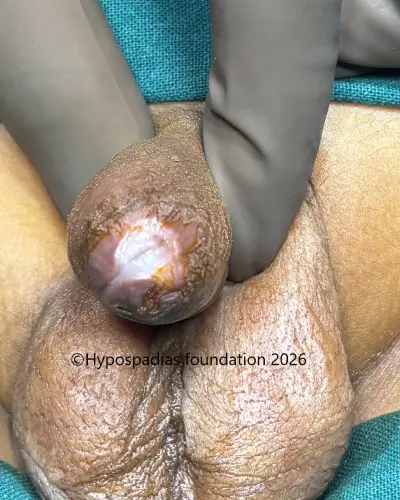
Pic 2: BXO (Balanitis Xerotica Obliterans) changes noted at the tip of foreskin

Unlike hypospadias repair, circumcision generally does not require urethral reconstruction or urinary catheterisation.

The Important Exception: MIP Variant of Hypospadias

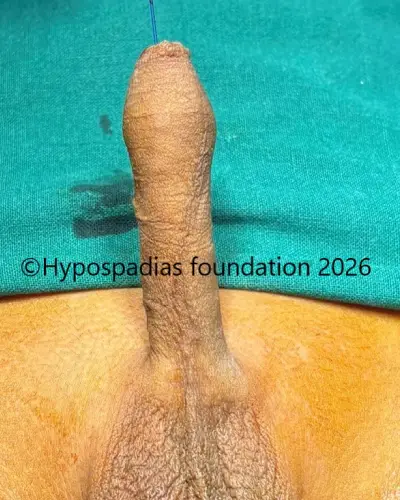
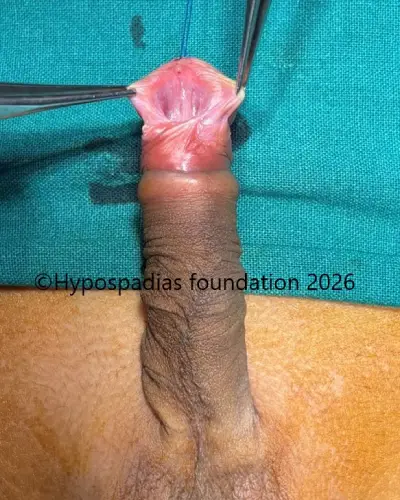
Not all hypospadias cases present with a hooded foreskin. A special subtype called the Megameatus Intact Prepuce (MIP) variant may have a completely normal foreskin.
Pic 3: MIP variant of hypospadias with complete prepuce

Because the foreskin appears normal, the diagnosis can occasionally be missed before circumcision. For this reason, surgeons should always retract the foreskin and examine the position of the urinary opening before beginning a circumcision procedure.

Take-Home Message

Circumcision does not correct hypospadias. Hypospadias is a reconstructive condition that requires correction of penile curvature and relocation of the urinary opening to the tip of the penis. In many cases, the foreskin plays an essential role in reconstruction and should be preserved until evaluation by an experienced hypospadias surgeon.

If your child has hypospadias or there is any doubt about the position of the urinary opening, consult a pediatric urologist or an experienced hypospadias specialist before proceeding with circumcision.

Hypospadias foundation is a centre located in Kharghar, Navi Mumbai, Maharashtra, India with surgeons having expertise in hypospadias repair in children and adults. We regularly manage both primary hypospadias repairs and complex cases including those with previous multiple failed repairs. A significant focus of our patient base consists of children and adults who have had failed hypospadias surgeries elsewhere. Our approach involves not just good surgical technique but also diligent pre-operative assessment, focussed post-surgery care and critical decision making for good long-term outcomes.

Dr A.K. Singal is the founder and head of hypospadias foundation, India. He is considered the best hypospadias surgeon in India and the world and has successfully treated thousands of children and adults with hypospadias with excellent results.

Dr Ashwitha Shenoy is an expert hypospadias surgeon with special interest in the field of hypospadias and pediatric urology. Both Dr Singal and Dr Shenoy strive toachieve excellent outcomes in adults and children with hypospadias. Our success rate at hypospadias foundation for all types of repairs including complex and failed repairs are more than 95%.

Contact Form for Hypospadias Foundation

Please fill all clinical details and upload pictures and clinical summaries (if available)

    Attach Documents (pdf | jpeg | mp4)
    (upload size upto 5mb)

    Is there an age limit for hypospadias repair surgery?

    Hypospadias is a congenital condition in which the urinary opening (meatus) is located on the underside of the penis instead of at the tip. Hypospadias repair surgery is a well-established and successful procedure that can be performed in infants, children, adolescents, and adults. However, choosing the best age for hypospadias repair plays an important role in healing, recovery, and long-term outcomes.

    What Is the Best Age for Hypospadias Surgery?

    Most expert hypospadias surgeons recommend performing surgery between 6 and 18 months of age. Surgery before 3 years of age is considered ideal, and if someone misses this period, surgery before 8 years of age is still strongly recommended if early repair was not possible.

    Hypospadias Surgery in Infants (6–18 Months)

    The ideal age for hypospadias surgery is between 6 and 18 months. At this age:

    • Penile tissues are soft, elastic, and heal faster
    • Scarring is minimal due to high tissue regeneration
    • Infants are unaware of their genitalia and body image
    • There is no psychological impact or memory of surgery

    Early hypospadias repair also allows normal toilet training and smooth bladder control development. Post-operative care is easier in infants, as diaper changes simplify wound care and recovery is less stressful for parents.

    Pic 1 for blog

    Hypospadias Surgery Before 3 Years of Age

    If surgery cannot be done in infancy, completing hypospadias repair before 3 years of age still provides excellent results. Children recover well, healing is fast, and long-term functional and cosmetic outcomes remain very good.

    Hypospadias Surgery in Older Children

    Hypospadias surgery in older children is safe and effective, though recovery can be more challenging.

    Older children:

    • Are more aware of their genitalia and may feel shy or anxious
    • Experience more fear and perceived pain after surgery
    • May find dressing changes difficult
    • Sometimes hold urine after catheter removal due to fear of pain

    Despite these challenges, healing and success rates remain high when surgery is performed by an experienced hypospadias surgeon.

    Hypospadias Surgery in Teenagers

    Teenage boys with untreated or failed hypospadias often feel embarrassed and reluctant to undergo surgery. In cases of hypospadias with chordee (penile curvature), we recommend delaying surgery until penile growth is complete. Avoiding surgery during active growth may prevent interference with natural penile development

    Hypospadias Surgery in Adults

    Hypospadias repair in adults is possible and can be highly successful. However, recovery is slower compared to children because:

    • Adult penile skin is thicker and less elastic
    • Healing takes longer
    • Pubic hair can affect wound care
    • Night-time erections may stress sutures and increase complication risk
    • Infection issues are higher
    • Urethral and extra safety supra-pubic catheter are also needed.

    Even in adulthood, good outcomes are achievable in expert hands. Adult hypospadias surgery success rates at Hypospadias Foundation India are over 95%, which are best in the world.

    Is There an Age Limit for Hypospadias Surgery?

    There is no upper age limit for hypospadias surgery. The success of repair depends more on the experience of the hypospadias surgeon than the age of the patient. With proper evaluation and surgical expertise, excellent results can be achieved even in adulthood.

    Importance of Choosing an Expert Hypospadias Surgeon

    Before planning hypospadias surgery, it is essential to consult a specialist hypospadias surgeon. An experienced surgeon will:

    • Carefully examine the child or adult
    • Assess severity, chordee, and previous surgeries
    • Recommend the best timing and surgical technique

    At Hypospadias Foundation, children and adults from over 30 countries undergo hypospadias repair. The oldest successfully treated patient was a 50-year-old man with failed hypospadias repair and urethral stricture, operated without complications. This highlights the importance of choosing a specialized center for hypospadias treatment.

    Dr A K Singal is a highly experienced and internationally renowned hypospadias surgeon in India, widely regarded as one of the leading experts in hypospadias repair for both children and adults. He has dedicated his professional life to the treatment of complex and failed hypospadias cases, helping patients achieve excellent functional and cosmetic outcomes.

    With decades of focused experience in primary and redo hypospadias surgery, Dr Singal’s expertise has contributed to consistently high success rates in infants, older children, adolescents, and adults with hypospadias.

    Dr Ashwitha Shenoy is an expert pediatric surgeon with a special interest in pediatric urology and hypospadias surgery. Her training and experience in managing hypospadias in children ensure meticulous surgical care, age-appropriate planning, and excellent long-term outcomes.

    Together, Dr A K Singal and Dr Ashwitha Shenoy work as a dedicated team to provide comprehensive hypospadias treatment in India. Their combined expertise allows them to manage simple to complex hypospadias cases, including failed repairs and adult hypospadias, delivering some of the best outcomes for hypospadias surgery in India.

    Contact us:

    For appointment kindly contact us at the contact details given below.

    MITR hospital & Hypospadias Foundation, Kharghar, Navi Mumbai, India – Tue/Saturday 4:00pm-6:00pm, Call for appointments: +91-6262840940. Or email us at hypospadiasfoundationindia@gmail.com

    Contact Form for Hypospadias Foundation

    Please fill all clinical details and upload pictures and clinical summaries (if available)

      Attach Documents (pdf | jpeg | mp4)
      (upload size upto 5mb)

      Does Hypospadias cause male infertility?

      For some men with hypospadias, a congenital condition where the urethral opening lies somewhere on the underside of the penis, questions about fertility can loom large. While hypospadias itself doesn’t directly impact sperm production, its associated complications can sometimes pose challenges. Hypospadias cause male infertility in certain cases due to these complications. But remember, this doesn’t mean that all men with hypospadias will necessarily be infertile. Let’s delve into the link between hypospadias and fertility, exploring potential concerns, available solutions, and fostering hope for fatherhood.

      Understanding Hypospadias:

      During fetal development, normally the urethra forms by folding of tissues from scrotum to the base of the penis to the tip of the penis. The failure of this urethral closure leads to hypospadias. The severity of hypospadias varies, with the opening appearing anywhere from the scrotum (scrotal hypospadias) to the base of the penis (penoscrotal hypospadias) to near the tip of the penis (distal hypospadias). Besides the misplaced opening, most men with hypospadias also have a downward bending of the penis during erection – called chordee. Hypospadias can cause male infertility as 5% of cases may also have an associated undescended or absent testis, which can lead to lower sperm production. Such men need to be investigated for a disorder of sex development (DSD) or intersex.

      Hypospadias and Fertility: the Possible Connections:

      In isolated hypospadias with both normal testes, the sperm production usually remains unaffected, yet certain hypospadias-related factors can influence fertility:
       Urethral location: In severe unrepaired hypospadias cases such as scrotal or perineal or penoscrotal hypospadias, ejaculation might not be able to reach the vaginal introitus, hindering fertilization.
       Penile curvature: Significant curvature can make intercourse physically difficult. Sometimes erection can also be painful when there is significant chordee
       Meatal stenosis: abnormal hypospadias opening may be very small leading to urinary and sperm flow obstruction.
       Prostatic utricular diverticulum: Some men with severe hypospadias may also have a large sac near their prostate gland where sperm tubes (vas deferens) open. In such cases sperms may not flow out easily for fertilisation.
       Post hypospadias surgery issues: At Hypospadias foundation, we see lot of men who have had repairs done earlier and have poor fertility though they have a normal sperm production. The common reasons for this are complications of hypospadias surgery such as: residual curvature or chordee, stricture in new passage, diverticulum or baggy new urethra or fistulae in the urethra.

       Psychological considerations: Emotional concerns about body image or sexual function can sometimes affect intimacy and overall fertility.

      Hypospadias Treatment Options: Paving the Way for having children
      Fortunately, advancements in hypospadias surgery and infertility treatment offer effective solutions for addressing hypospadias-related fertility concerns:
       Hypospadias repair surgery: This procedure reconstructs the urethra and corrects penile curvature, often restoring normal ejaculation and improving sexual function. If there are complications from previous hypospadias surgeries such as stricture, residual chordee, fistula or a diverticulum- these can be repaired by an expert hypospadias surgeon leading to cure for infertility.
       Assisted reproductive technologies (ART): In cases where natural conception proves challenging, sperm retrieval techniques like testicular biopsy or micro epididymal sperm aspiration (MESA) can be combined with IUI, IVF, or ICSI to achieve pregnancy.

      Maintaining Hope: Fatherhood is Within Reach for people with Hypospadias:
      Do consult an expert and best hypospadias surgeon first. The hypospadias surgeon will check and confirm that the hypospadias repair is proper and there is no structural issue in repair. If there is some residual issue in hypospadias surgery, then that needs to be corrected first. If the infertility persists, and you suspect hypospadias cause male infertility, then you must visit an andrologist for assisted reproductive techniques.

      It’s crucial to remember:
       The majority of men with hypospadias have normal fertility.
       Early surgical intervention significantly improves the chances of successful fatherhood.
       Advanced treatments like ART offer alternative paths to parenthood. Open communication with your hypospadias doctor is key to understanding your unique
      situation and exploring suitable fertility options. Remember, hypospadias does not define your potential as a father. With proper support and available treatments, you can navigate this journey and realize your dreams of having babies and building a family. At Hypospadias foundation, we treat hundreds of children and adults with hypospadias every year. Since 2008, Dr A.K.Singal, rated as the best pediatric urologist and hypospadias surgeon in India and the world, has devoted his life to helping people with hypospadias get best results and normal life. Along with Dr Ashwitha Shenoy, pediatric surgeon and hypospadias surgeon and a partner at Hypospadias foundation, the team at Hypospadias foundation, has deep expertise in diagnosing and treating complex hypospadias.

      References:
       American Urological
      Association: https://university.auanet.org/core/pediatric/hypospadias/index.cfm
       National Institutes of Health: https://www.ncbi.nlm.nih.gov/books/NBK482122/
       Mayo Clinic: https://www.mayoclinic.org/diseases-
      conditions/hypospadias/diagnosis-treatment/drc-20355153

      If you wish to have a teleconsult or a second opinion from Dr Singal/ Dr Shenoy, please write to us hypospadiasfoundationindia@gmail.com or fill up this contact form: https://www.hypospadiasfoundation.com/contact/

      Dr A.K.Singal presents his work at Hypospadias World Congress at Childrens Hospital of Philadelphia, USA

      Hypospadias Foundation starts Clinic for Hypospadias Treatment & Surgery in Bahrain

      Dr A.K.Singal was an invited speaker at Hypospadias World Congress at Children’s Research Center at Children’s Hospital of Philadelphia, USA, held between 30th October 2019-1st Nov 2019. Dr Singal presented four papers on hypospadias treatment and moderated scientific sessions during the conference.

      The conference saw participation from more than 150 pediatric urologists and hypospadias specialists from across the world. The conference solely focussed on hypospadias. Various aspects of hypospadias were discussed such as etiology, diagnosis, hormonal tests and supplementation (testosterone injections), surgery techniques and complications/ results of hypospadias surgeries.

      Dr A.K.Singal

      Dr A.K.Singal

      best hypospadias surgeon in india

      Dr Singal with Dr Long & Dr Zaontz

      Dr Singal presented the following lectures and papers in the World Congress:

      • Buccal inlay graft for failed hypospadias- Dr Singal showed technique of buccal (oral) mucosa graft inlay surgery and its results in failed hypospadias cases.
      • Considerations in adult hypospadias repairs- Adult hypospadias are difficult to manage especially if the surgery done in childhood has failed. Dr Singal showed innovative surgery techniques for such adult hypospadias cases for best outcomes.
      • Reimagined Byar’s flaps for staged hypospadias repairs- For hypospadias with severe chordee, it is important that the penile curvature gets fully corrected in first stage and then second stage surgery is done for bringing the urethra to the tip of penis. In expert hands the results of two stage surgery for hypospadias with severe chordee is very good. Dr Singal showed finer nuances of surgery to achieve best results to the audience.
      • Parental Awareness survey for families with hypospadias: Families of children or adults with hypospadias are often not fully aware of the extent of disease and what it means in the long run. Dr Singal and his team conducted a study of 150 families to understand about their concerns about hypospadias and their knowledge level about the disease/ surgery.

      Overall the three-day conference resulted in great mutual exchange of ideas and also helped younger generation of surgeons learn from eminent faculty from all over the world.

      Contact Us

      Call Now