Hypospadias vs Circumcision

Hypospadias vs Circumcision: Why Circumcision Alone Cannot Fix Hypospadias

One of the most common questions parents ask when their child is diagnosed with hypospadias is: “Can circumcision alone correct hypospadias?”

The simple answer is no. Circumcision and hypospadias repair are two very different surgical procedures, and understanding the distinction is crucial for achieving the best outcome for your child.

What is Hypospadias?

Hypospadias is a congenital condition in which the urinary opening (meatus) is located on the underside of the penis instead of at the tip. It is often associated with:

 A hooded foreskin (foreskin present on the upper side but deficient on the
underside)
 Penile curvature (chordee)
 Abnormal urinary stream

The goals of hypospadias surgery are to straighten the penis, reconstruct the urethra, and create a normal appearance.
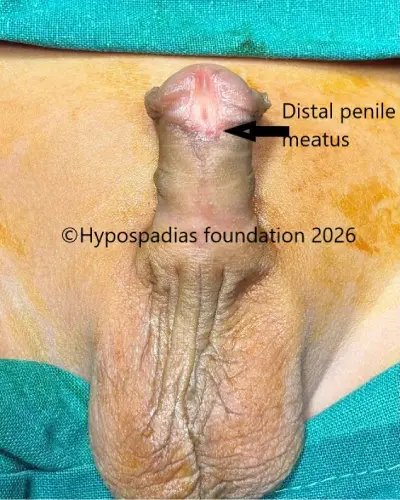
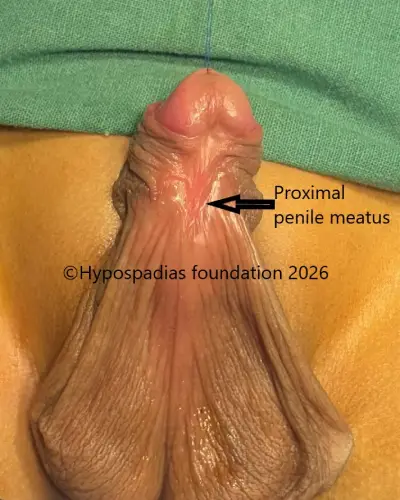
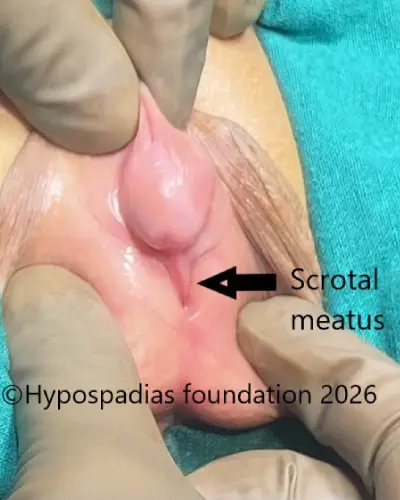
Pic 1: Case of distal penile, proximal penile and scrotal hypospadias

What Does Hypospadias Repair Involve?

Hypospadias surgery is a reconstructive procedure that is far more extensive than a circumcision. Depending on the severity of the condition, the surgery involves the following steps:

1. Degloving

The penile skin is carefully mobilized around the shaft to release adhesions, fibrotic strands and correct any skin-related curvature.

2. Chordee Assessment

An artificial erection test is performed during surgery to assess the degree of penile curvature. The severity of chordee helps determine whether a single-stage or two-stage repair is required.

 Chordee less than 30 degrees: Usually suitable for single-stage repair.
 Chordee greater than 30 degrees: Often requires more extensive reconstruction and sometimes a staged approach.

3. Chordee Correction

Depending on the degree of curvature, correction may be achieved through:

 Dorsal tunica albuginea plication for mild curvature
 Urethral plate division
 Urethral mobilization
 Corporotomies
 Ventral lengthening procedures using dermal grafts or pericardial patches for severe curvature

4. Urethroplasty

Once the penis is straightened, the urethra is reconstructed to bring the urinary opening to the tip of the penis.

5. Circumcision

The foreskin is frequently used during hypospadias reconstruction to create the new urethra and provide skin coverage on the underside of the penis. As a result, the foreskin is usually consumed during the repair process, making circumcision a component of the surgery rather than the treatment itself.

Why Circumcision Alone Cannot Correct Hypospadias

Circumcision simply removes the foreskin. It does not:

 Correct penile curvature
 Reconstruct the urethra
 Move the urinary opening to the tip of the penis

Therefore, circumcision alone cannot treat hypospadias.

In fact, performing circumcision before a planned hypospadias repair can create significant challenges because the foreskin is often needed for reconstruction. Loss of this tissue may limit surgical options and can sometimes convert a straightforward single-stage repair into a more complex two-stage procedure.

What to Expect After Hypospadias Surgery

Following hypospadias repair:

 A dressing is placed around the penis.
 A urinary catheter is usually left in place to drain urine.
 The dressing and catheter are typically removed after 7–10 days, depending on the type of repair performed.

The final appearance is usually that of a circumcised penis because the foreskin has been used during reconstruction. The foreskin does not regrow, as it was either deficient from birth or utilized during surgery.

Attempts to reconstruct the foreskin solely for cosmetic purposes may increase the risk of complications such as tightness, scarring, or breakdown of the repair.

How is Circumcision Different?

Circumcision is a relatively minor procedure involving removal of the foreskin covering the glans penis. Common indications include:

 Recurrent phimosis
 Recurrent foreskin infections
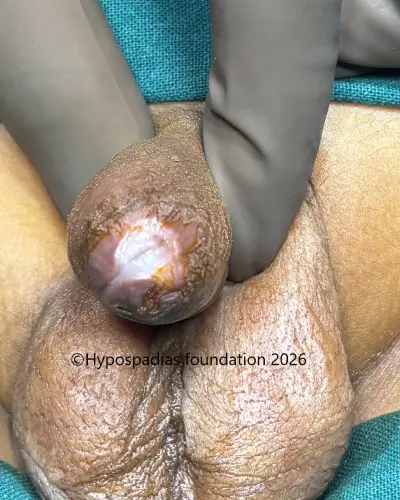
 Balanitis Xerotica Obliterans (BXO)
 Failure of medical treatment for phimosis
 Religious or cultural reasons

Pic 2: BXO (Balanitis Xerotica Obliterans) changes noted at the tip of foreskin

Unlike hypospadias repair, circumcision generally does not require urethral reconstruction or urinary catheterisation.

The Important Exception: MIP Variant of Hypospadias

Not all hypospadias cases present with a hooded foreskin. A special subtype called the Megameatus Intact Prepuce (MIP) variant may have a completely normal foreskin.
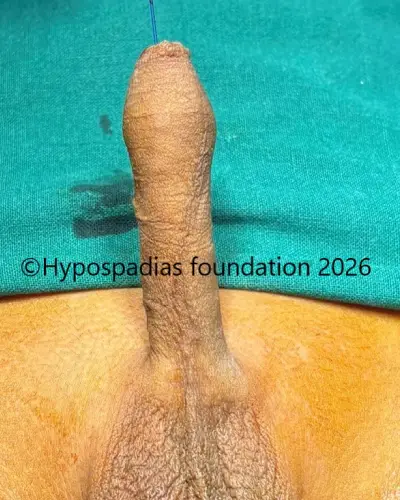
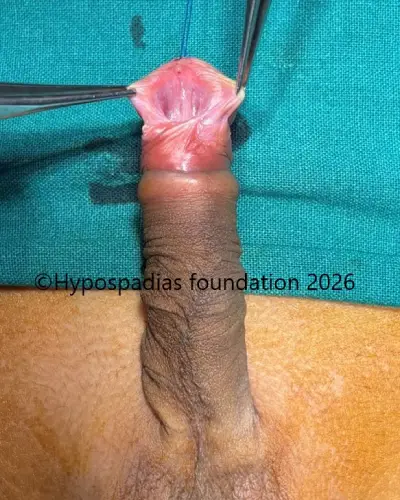
Pic 3: MIP variant of hypospadias with complete prepuce

Because the foreskin appears normal, the diagnosis can occasionally be missed before circumcision. For this reason, surgeons should always retract the foreskin and examine the position of the urinary opening before beginning a circumcision procedure.

Take-Home Message

Circumcision does not correct hypospadias. Hypospadias is a reconstructive condition that requires correction of penile curvature and relocation of the urinary opening to the tip of the penis. In many cases, the foreskin plays an essential role in reconstruction and should be preserved until evaluation by an experienced hypospadias surgeon.

If your child has hypospadias or there is any doubt about the position of the urinary opening, consult a pediatric urologist or an experienced hypospadias specialist before proceeding with circumcision.

Hypospadias foundation is a centre located in Kharghar, Navi Mumbai, Maharashtra, India with surgeons having expertise in hypospadias repair in children and adults. We regularly manage both primary hypospadias repairs and complex cases including those with previous multiple failed repairs. A significant focus of our patient base consists of children and adults who have had failed hypospadias surgeries elsewhere. Our approach involves not just good surgical technique but also diligent pre-operative assessment, focussed post-surgery care and critical decision making for good long-term outcomes.

Dr A.K. Singal is the founder and head of hypospadias foundation, India. He is considered the best hypospadias surgeon in India and the world and has successfully treated thousands of children and adults with hypospadias with excellent results.

Dr Ashwitha Shenoy is an expert hypospadias surgeon with special interest in the field of hypospadias and pediatric urology. Both Dr Singal and Dr Shenoy strive toachieve excellent outcomes in adults and children with hypospadias. Our success rate at hypospadias foundation for all types of repairs including complex and failed repairs are more than 95%.

Contact Form for Hypospadias Foundation

Please fill all clinical details and upload pictures and clinical summaries (if available)

    Attach Documents (pdf | jpeg | mp4)
    (upload size upto 5mb)

    Typical worries in parents of boys with hypospadias

    Hypospadias though common is still unknown to the general population. When a parent finds out that their child has a genital abnormality (hypospadias) they get very worried thinking of the child’s future, which often leads to heightened parental worries. Due to limited resources which are available in the online platform, parents do not get a clear idea when it comes to hypospadias. This blog is directed to parents who have children with hypospadias, to ease their concern and improve the knowledge surrounding hypospadias and parental worries.

    1. Is surgery needed for Hypospadias? Surgery is required in hypospadias to correct the chordee, to create a urinary passage and bring the opening to the tip of the penis. The repair can be staged or single stage depending on the degree of chordee (downward bent of the penis) and severity of hypospadias. The risk of complications following surgery at our centre is less than 5%. The most common complications which we encounter are wound infection, fistula formation, diverticulum formation and meatal stenosis. An additional surgery may be required in some of these complications. Following hypospadias surgery, the cosmetic result will be similar to a circumcised penis. The meatus will be at the tip on the glans and the child would be able to pass urine in a single straight stream.
    2. Anaesthesia during hypospadias surgery: Hypospadias surgeries are done under general anaesthesia. It is important that besides a pediatric urologist, a pediatric anesthesiologist doctor is available to give anesthesia safely to children. Right from dosage of medications to managing airway is very different in children when compared to adults. Hence, at Hypospadias Foundation we have 3 skilled pediatric anesthesia experts who give anesthesia for hypospadias surgery. In addition to general anaesthesia the anaesthetist will also give an injection in the lower spine (caudal anaesthesia) which gives good pain relief to children for 12 hours after the surgery. Pain relief is our priority after surgery so that children can be comfortable after surgery and don’t remember hospitalisation as a painful episode. Besides caudal anaesthesia(during the surgery), we provide adequate pain relief with analgesics for a few days post-surgery.
    3. Pain after hypospadias surgery: Besides common surgical pain, which is easily manageable with pain killer medicines, two main reasons why children can develop pain in the post operative period are either due to bladder spasms or erections. Bladder spasms are controlled by a tablet oxybutynin which is started after the surgery and is continued till the catheter removal. Erection in the penis mainly occurs during early morning hours but can occur anytime in the day. Mostly the pain which occurs during erection is also managed well by the painkillers. The pain decreases significantly once the dressing and catheter are removed. However, penis continues to be sensitive for 2-3 weeks after the hypospadias repair surgery.
    4. Infertility in hypospadias:  Hypospadias can cause male infertility due to various reasons. They may be due to abnormal location of the meatus, presence of chordee and low semen count. The altered opening of the urethra can cause problems in ejaculation, hence causing infertility. Presence of chordee can make sexual intercourse difficult or painful. Presence of an associated undescended testis may be associated with a low sperm count. We need to understand that not all men with hypospadias will have fertility problems. The severity of hypospadias and the success of surgical repair will ultimately decide if they will be able to father a child. Hence in men with hypospadias suffering from infertility they need to get in touch with a hypospadias surgeon because getting the hypospadias repaired will increase their chances of having children.  
    5. Risk of hypospadias in future generation: The risk of hypospadias in future generations is influenced by a number of factors such as genetic and environmental factors. Some studies suggest that the risk of hypospadias may be increasing. The prevalence of hypospadias in the United states has increased by 10% from 1970 and 2000 as per the study published in the journal Nature in 2011. Hypospadias is a condition that can be inherited from the parents. If the father has hypospadias, then the risk of developing hypospadias in future generations will be 5-10%. Similarly, if first child has hypospadias, the risk in second boy is almost 5%. 
    6. Cost of surgery and insurance coverage/cashless/mediclaim: Hypospadias being a penis birth defect is classified as an external birth defect which can be easily diagnosed as soon as the baby is born. Hence, if parents take an insurance policy after the baby is born, hypospadias surgery treatment costs as cashless Mediclaim are not covered by most of the insurance companies in India atleast while in USA, UK it is covered under insurance benefits. The situation is different for some of the corporate insurance group policy holders. Some big corporates issue very employee friendly mediclaim policies which cover all medical and surgical treatments for the employees and their families. Such mediclaim policies may cover all pre-existing as well as birth defects for their employees and hence hypospadias repair procedure may be covered by the insurance companies in these circumstances.

    At Hypospadias foundation, we see almost 500 children and adults with hypospadias every year. The counselling in clinic, before surgery and after surgery focussing on making the families and patients comfortable, increasing their knowledge, and solving their queries regarding Hypospadias and parental worries. While there may be information available with pediatricians or on google, it is always better to consult a specialist hypospadias surgeon to have genuine answers to all the questions.


    Fill up contact form: https://www.hypospadiasfoundation.com/contact/

    Contact Form for Hypospadias Foundation

    Please fill all clinical details and upload pictures and clinical summaries (if available)

      Attach Documents (pdf | jpeg | mp4)
      (upload size upto 5mb)

      Single Stage Repair Surgery for Distal Hypospadias and Penile Torsion

      Hypospadias Foundation starts Clinic for Hypospadias Treatment & Surgery in Bahrain

      A 10-month-old child was brought with complaints of deviation of urine stream and abnormal location of meatus. On clinical examination, there was distal penile hypospadias with severe penile torsion measuring 90 degrees to the left. We planned a single-stage correction for both Surgery for Distal Hypospadias and Penile Torsion, addressing both conditions simultaneously to optimize outcomes efficiently.

      Penile torsion

      Notice Penile torsion to left

      Distal Hypospadias with Penile torsion

      Surgery Steps:

      Marking of the degloving incision, a crucial step in surgery for distal hypospadias and penile torsion, commenced the procedure. Local anesthesia was meticulously infiltrated at the marked incision site to ensure patient comfort. The surgical process proceeded with complete degloving and assessment of chordee, revealing a 30-degree chordee. Chordee correction was expertly performed through Tunica albuginea plication at 12 o’clock on the dorsal side, resulting in the successful elimination of chordee. Urethroplasty commenced with precise incision of the urethral plate in the midline, followed by meticulous suturing over a 7Fr Infant feeding tube with 6-0 PDS continuous sutures. Additional measures included the harvesting of a Dartos flap for extra coverage over the urethroplasty, secured with 6-0 PDS sutures. Penoscrotal web correction was also addressed, with excess skin excised and meticulously sutured using 5-0 vicryl rapide. To address penile torsion, skin flaps were rotated and adjusted, ensuring optimal alignment, and meticulously sutured all around using 5-0 vicryl rapide. Postoperative care included a 7-day period with dressing and catheter in situ, followed by their removal to facilitate the patient’s recovery.

      Penile torsion and Hypospadias repair

      Finished Hypospadias and Penile torsion surgery

      Surgery for Distal Hypospadias and Penile Torsion

      Final outcome of correction of penile torsion and hypospadias

      Results

      The Final result was very gratifying with a straight penis without any torsion. The child was passing urine in good stream in straight axis without any discomfort or pain.

      About Hypospadias repair and penile torsion

      Penile torsion is a condition wherein the penis is rotated or twisted on its axis. The penile torsion is more commonly to the left. Many a time penile torsion may not be detected till a circumcision is planned or foreskin is retracted.

      Penile torsion may be associated with hypospadias and/or chordee (penile curvature). With hypospadias, penile torsion is mostly associated with distal penile cases.

      Based on the degree of glanular rotation, penile torsion can be classified as mild, moderate, and severe. It is mild if its less than 45 degree, moderate if it’s between 45-90 degree and severe if more than 90 degree.

      Penile torsion in majority of cases (>85%) is between 10 to 20 degree. If it is a moderate or severe degree of torsion, urine stream may be deviated to one side.

      Surgical intervention is not always required in isolated penile torsion. The indications for surgical correction are cosmetic, functional, or sexual. When penile torsion is associated with hypospadias, it should be corrected along with Hypospadias repair or urethroplasty at the same time.

      About Hypospadias Foundation

      Hypospadias foundation is a centre which provides personalized and best quality care for children and adults with hypospadias. It is one of the best hospital centres in India and world for surgical treatment for hypospadias in adults and children.  Our dedication in the field of hypospadias has helped us achieve excellent outcomes in these patients. We treat children and adults not only from various parts of India but also from more than 25 countries all over the world. Hypospadias foundation is located at MITR hospital in Kharghar, Navi-Mumbai, Maharashtra, India. Every year more than 200 surgeries for hypospadias are performed at MITR hospital and Hypospadias Foundation

      Contact us:

      For appointment kindly contact us at the contact details given below.

      • MITR hospital & Hypospadias Foundation, Kharghar, Navi Mumbai, India
      • MITR Clinic: C1/8 Ground floor, Sector-2, VashiCall

      Call for appointments: +91-2227743558/ 27744229/ 39/69 and +919324180553.

      Or you can fill up this form- Contact form for Dr Singal


      Fill up contact form: https://www.hypospadiasfoundation.com/contact/

      Single stage buccal mucosa graft urethroplasty for an adult with failed hypospadias

      Hypospadias Foundation starts Clinic for Hypospadias Treatment & Surgery in Bahrain

      Hypospadias is a common congenital birth defect which occurs in 1/150 boys in India. 20-30 years back the treatment for hypospadias was very not very successful as the procedure and surgical techniques very not very refined, the number of expert hypospadias surgeons focussed on treatment was less, sutures and instruments for hypospadias surgery were also very basic. With advancing knowledge and expertise, these days in 2019, the results of hypospadias repair (urethroplasty) are much better. A lot of adults in this century, underwent surgery as children way back in 1980’s and 1990’s and some of them did not get good results even after multiple hypospadias surgeries due to complications. Some of these people lost hope at a cure and did not pursue further surgery for failed hypospadias. At Hypospadias Foundation, we regularly get such young adults who come from all over India to seek best treatment and cure for Hypospadias. One of the new techniques to cure such adults with hypospadias is to use skin from inside the mouth for making new urethra- called oral or buccal mucosa graft urethroplasty. In hands of an expert surgeon, it has extremely good results.

      Case History:

      Mr A.G. 26 years old young man, engineer by profession, extremely smart and suave in nature, came to our hypospadias clinic one evening. He sat down and talked about the trauma of two failed hypospadias surgery which he underwent in Indore with a plastic surgeon. The last surgery was about 10 years back. He had lost hope for cure till he stumbled upon Hypospadias Foundation while searching online. He had come with a hope to get a cure for his hypospadias issue and get married soon. His present problem was thin stream of urine, pain while passing and leak of urine from underside of penis. On examination, his penis was straight (no chordee), he had a fistula in proximal penile region with thin unhealthy urethra. We sat with him and explained the plan to do a cystoscopy and check for quality of urethra and find out reason for repeated failure of surgery and then decide whether a one stage or two stage surgery is needed for full cure and best results of hypospadias surgery. A.G. agreed for the plan and wanted the best treatment.

      Surgery:

      On cystoscopy, we saw that his new urethra was thin and unhealthy. We cut it open from tip of penis to the site of fistula and actually little below that. We saw that the dorsal wall (roof of urethra) was healthy with minor scarring. We made a deep cut in the dorsal wall in the central midline. We took a buccal graft (oral or labial graft) from upper lip. The graft was fixed with absorbable sutures in the midline to form a part of the neo-urethra. The graft and surrounding urethral wall were rolled into a tube with absorbable sutures around a 14 Fr silicon catheter – all in one stage. The unhealthy skin was excised, and closure of skin also done in a cosmetic way. The catheter was removed after 3 weeks and at one month after catheter removal AG was passing urine in a thick stream without pain from the tip of penis. He was very happy and planning to get married soon. We advised him to marry atleast 6 months after hypospadias surgery. The new urethra is still a bit fragile for 3-4 months after surgery and it is better to wait for 6 months for intercourse (coitus/ sex) after surgery.

      Buccal (oral) mucosa graft urethroplasty in adults:

      An adult with multiple failed hypospadias surgeries, generally has no normal penile skin or prepuce left for hypospadias repair using local tissues from penis. Hence in such patients, it may be better to use skin from inside the mouth for making the new passage. The skin can be easily taken from inside of cheek or lips. The defect heals very fast and generally without much complications. The buccal graft adapts to penile location very well and has great long-term results in failed surgery. While some of these cases are suitable for a single stage surgery, some may require two stage surgery depending on the severity of the defect. Nonetheless, Buccal Graft Urethroplasty remains a great option with best long-term results for children and adults with Failed Hypospadias.

      At Hypospadias Foundation in India, Dr Singal and his team have one of the best hypospadias surgery results in the world. Children and adults from more than 20 countries such as UAE, Bahrain, Iran, Iraq, Afghanistan, Saudi Arabia, Pakistan, Bangladesh, Malaysia, Tanzania, Nigeria, Congo, Ethiopia, Kenya, Nepal, Indonesia, Egypt, Jordan etc come for treatment at our foundation. It is indeed heartening to see them go back with final cure from hypospadias.

      To contact us write an email to hypospadiasfoundationindia@gmail.com or contact us at +91-9821261448 between 9am-6pm India time or fill up this form for enquiry.

      Watch Buccal Mucosa Graft Urethroplasty Video here:

      Watch Two staged Buccal Mucosa repair surgery in a child:

      Contact Us

      Call Now