Failed Hypospadias with distal penile fistula – Single stage redo urethroplasty

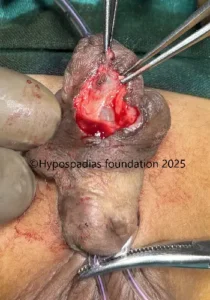
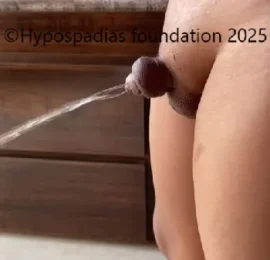
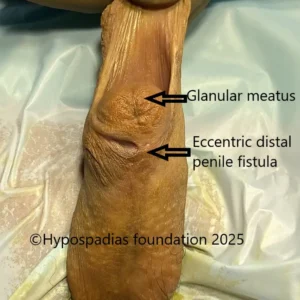
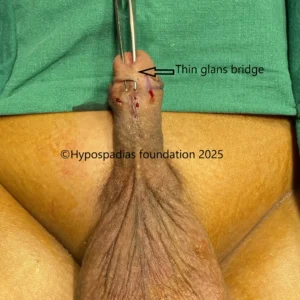
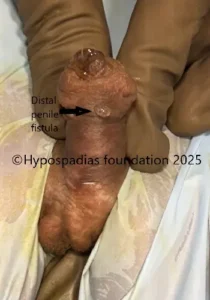
Mast B.E, 14-year male from Mumbai had undergone two unsuccessful hypospadias repairs at another hospital in the past. He presented to Hypospadias Foundation with complaints of passing urine from two sites, which is from the tip and from the distal penile region. On clinical examination, there was an eccentric subcoronal fistula with a thin glans bridge separating it from the glanular meatus. There was some residual skin on the dorsal side. The urine stream was spraying as shown in the photo below
46c1
46c2

Picture 1: On clinical examination, there was an eccentric distal penile fistula with thin glans bridge separating it from the glanular meatus
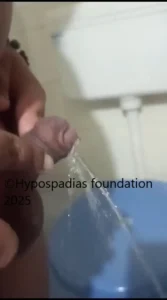
Picture 2: Urine stream was poor with spraying of urine.

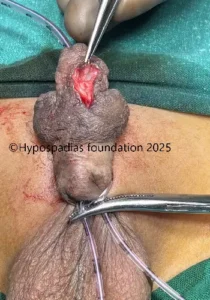
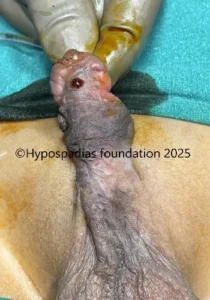
He was planned for single/ two stage repair depending on the degree of chordee, status of native urethra and quality of urethral plate. Cystoscopy was noted to be normal. Chordee assessment showed no residual chordee. The thin glans bridge between the meatus and the fistula was divided. The urethral plate was noted to be wide with no scarring. Considering all the above factors he was planned for single stage repair – simple tube urethroplasty or Glans Approximation Procedure was decided.
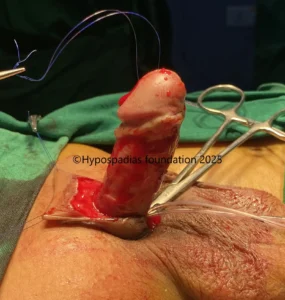
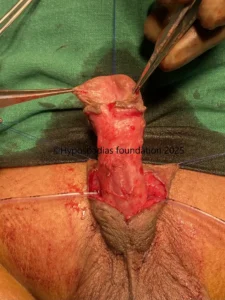
Picture 2: Artificial erection test showed no residual chordee. Urethral plate was noted to be wide and healthy.

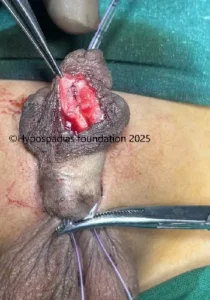
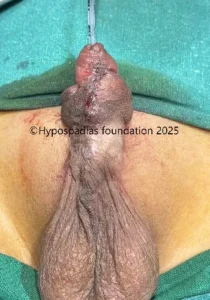
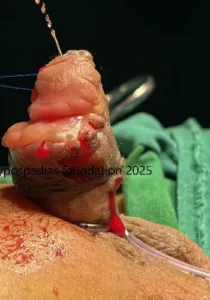
Stay suture was taken on the glans with 4-0 prolene. Complete degloving was done. Artificial erection test showed no residual chordee. Glans wings were marked and raised. Urethroplasty was done by continuous inverting subcuticular sutures with 6-0 PDS over 8Fr infant feeding tube. Second layer closed over the urethroplasty with local tissues with 6-0 PDS interrupted sutures. Right dartos flap was raised and sutured over the urethroplasty with 6-0 PDS. Glansplasty was done with 5-0 vicryl. Unhealthy skin was excised; edges were freshened and closed in 2 layers with 6 0 PDS and 6-0 vicryl rapide.
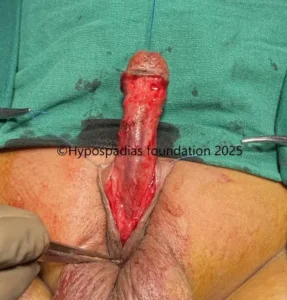
Picture 3: Complete degloving done and chordee assessed by artificial erection test. No chordee noted.
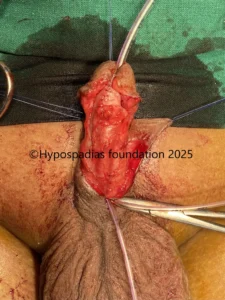
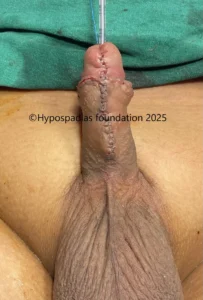
Picture 4: Urethroplasty done with 6-0 PDS, followed by glansplasty and skin closure
46c9
46c10

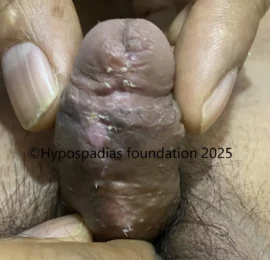
Picture 5: Appearance and urine stream at 2 weeks after catheter removal
46c11 (1) (1)

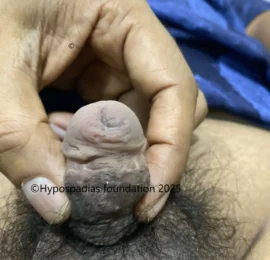
Picture 6: Follow up at 6 months after surgery

Click here to watch the entire video of this surgery
Redo urethroplasty for a distal urethral fistula – Hypospadias Foundation, India

Redo urethroplasty for failed hypospadias

Redo urethroplasty for failed hypospadias is a highly complex and challenging surgical procedure. The primary goal is to address the complications of the initial surgery which are often associated with tissue scarring, shortage of tissues and presence of residual chordee. The general goals for any redo urethroplasty are to straighten the penis (correct any residual chordee), to reconstruct the urethra (create
a new wide and patent urinary passage) and place the urinary opening at the tip of the penis (glanular meatus).

Redo hypospadias repair should be performed by a experienced pediatric urologist or hypospadias surgeon who has expertise in complex hypospadias repairs. Surgeon should wait atleast 6 months after the initial repair to allow the inflammation to subside and for the scar tissue to soften. Sometimes if there is significant scarring, we wait for even 1-2 years and use steroid creams to soften the scar area.

About Hypospadias Foundation

Hypospadias Foundation is a centre specialized for treatment of children with hypospadias. It is located at MITR hospital, Kharghar, Navi Mumbai in the state of Maharashtra, India. Our expertise in primary and redo hypospadias repair makes us one of the best centres for hypospadias treatment in the world. We get children from more than 30 countries in the world with various types of complications after hypospadias surgery done at other centres and we are able to repair them successfully with good cosmetic outcomes. This is possible because of our dedication in the field of hypospadias.

Dr A K Singal is an expert and top hypospadias surgeon in India. He is a gifted surgeon and his expertise in this area has helped us achieve excellent outcomes in primary and failed hypospadias in children as well as adults.

Dr Ashwitha Shenoy is an expert hypospadias surgeon with special interest in hypospadias and pediatric urology. Both Dr Singal and Dr Shenoy work together to give best results for hypospadias surgery in India for both children and adults.
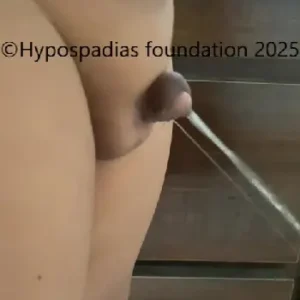
Single stage hypospadias repair in a child with recurrent distal penile fistula

A urethral fistula after hypospadias repair is an abnormal communication that forms between the newly reconstructed urethra and the skin on the underside of the penis. This is the most common complication that occurs after hypospadias surgery. In this condition, the urine comes from the tip of the penis and leaks from the fistula site.

This fistula mostly occurs due to issues with healing of the urethra. The common reasons include tension on the newly reconstructed urethra, poor blood supply at the operated site, gaps during closure, infection at the operated site, narrowing or stricture formation in the new urethra or straining while passing stool in the post operative period.

Children who form fistula after hypospadias surgery come with leaking or dribbling of urine from the fistula site. Symptoms usually appear within a few weeks to months after the initial hypospadias repair.

The primary treatment is surgical repair if they do not close on their own. It is standard practice to wait for atleast 6 months after the initial hypospadias repair before attempting fistula closure. This allows the tissues at the urethral fistula site to soften, improve blood supply and increase the success rate of second surgery. The fistula tract is identified and excised to create healthy tissue edges for repair.

The urethral fistula site is closed in multiple layers as done in the above-mentioned case to ensure a watertight seal and prevent recurrence. Before closing the fistula, it is always necessary to confirm that the urethra beyond the fistula site is not narrow or tight. In the presence of distal obstruction, the urethral fistula closure surgery may fail.

If your child has developed urethral fistula after hypospadias repair, then it’s necessary that you see a hypospadias specialist who will assess what is best for your child and choose the best technique minimizing the risk of complications and improving the chances of success.

About Hypospadias Foundation

Hypospadias Foundation is a centre specialized for treatment of children with hypospadias. Hypospadias foundation is located at MITR Hospital in Kharghar, Navi Mumbai in the state of Maharashtra. Our expertise in hypospadias makes us one of the best centres for hypospadias repair in the world. We treat children from more than 25 countries in the world and from all over India. Our dedication in this field has helped us achieve excellent outcomes.

Dr A K Singal is an expert and top hypospadias surgeon in India. He is a gifted surgeon and his expertise in this area has helped us achieve excellent outcomes in primary and failed hypospadias in children as well as adults.

Dr Ashwitha Shenoy is an expert hypospadias surgeon with special interest in hypospadias and pediatric urology. Both Dr Singal and Dr Shenoy work together to give best results for hypospadias surgery in India for both children and adults.
Single stage Redo hypospadias repair in a child with recurrent distal penile fistula

Single stage Redo hypospadias repair in a child with recurrent distal penile fistula

3-and-a-half-year-old male was diagnosed with penoscrotal hypospadias at birth. He underwent single stage urethroplasty at 1 and half year of age at another centre. Following the urethroplasty, he developed urine leak from the distal penile region. A second surgery was done to close the fistula. Unfortunately, the fistula recurred. Parents were disappointed and visited hypospadias foundation for treatment of their child.

We examined the child in the OPD and noted that there was a small fistula in the distal penile region with a normal meatus on the glans. He was passing urine mainly from the meatus (95%) and with a leak from the distal penile region (5%).

At hypospadias foundation, after examination we counselled the family for surgical repair which would be dependent on the quality of urethra, any residual chordee and blood supply to the tissues. While we aim to do a single stage repair for such cases, in some cases a decision to do a staged repair may be made during surgery.

On cystoscopy, a ledge was noted at the junction of normal urethra and reconstructed urethra. On artificial erection test, there was no residual chordee. The tissues were also healthy around the fistula. The findings were in favour of single stage fistula closure; hence we proceeded with the same.

Fistula site was marked. Local anesthesia with adrenaline was infiltrated at the marked site. Incision was given around the fistula site. Fistula site was mobilized all around and tract was completely excised. Fistula site was closed in 2 layers with 6-0 PDS over a 7Fr infant feeding tube. Local flap along with underlying dartos tissue was raised and sutured over the fistula site to decrease the risk of recurrent fistula formation. Skin was closed in 2 layers with 6-0 PDS and 6-0 vicryl rapide. The ledge in the distal urethra was incised. Post surgery, the dressing along with the catheter was removed on post operative day 7. Post catheter removal, he was passing urine in single straight stream with no pain or leak.

KP (10)

Pic 1: Pre surgery urine stream – Passing from meatus at the tip and from the fistula at distal penile region

Pic 2: Preoperative assessment shows fistula in the distal penile region.

Pic 3: Artificial erection test showed no chordee

Pic 4: Incision given around the fistula site and fistula mobilized all around

Pic 5: Fistula site closed in 2 layers. Skin along with dartos flap closed over the fistula closure site.

KP (8)

Pic 6: Post operative – good outcome at 2 months after surgery- passing urine in single straight stream with no leak

Click on this link to watch this video of fistula repair in redo hypospadias with recurrent fistula Fistula closure in redo hypospadias with recurrent fistula – Dr A.K.Singal/ Dr Ashwitha Shenoy – YouTube

Single stage hypospadias repair in a child with recurrent distal penile fistula

A urethral fistula after hypospadias repair is an abnormal communication that forms between the newly reconstructed urethra and the skin on the underside of the penis. This is the most common complication that occurs after hypospadias surgery. In this condition, the urine comes from the tip of the penis and leaks from the fistula site.

This fistula mostly occurs due to issues with healing of the urethra. The common reasons include tension on the newly reconstructed urethra, poor blood supply at the operated site, gaps during closure, infection at the operated site, narrowing or stricture formation in the new urethra or straining while passing stool in the post operative period.

Children who form fistula after hypospadias surgery come with leaking or dribbling of urine from the fistula site. Symptoms usually appear within a few weeks to months after the initial hypospadias repair.

The primary treatment is surgical repair if they do not close on their own. It is standard practice to wait for atleast 6 months after the initial hypospadias repair before attempting fistula closure. This allows the tissues at the urethral fistula site to soften, improve blood supply and increase the success rate of second surgery. The fistula tract is identified and excised to create healthy tissue edges for repair.

The urethral fistula site is closed in multiple layers as done in the above-mentioned case to ensure a watertight seal and prevent recurrence. Before closing the fistula, it is always necessary to confirm that the urethra beyond the fistula site is not narrow or tight. In the presence of distal obstruction, the urethral fistula closure surgery may fail.

If your child has developed urethral fistula after hypospadias repair, then it’s necessary that you see a hypospadias specialist who will assess what is best for your child and choose the best technique minimizing the risk of complications and improving the chances of success.

About Hypospadias Foundation

Hypospadias Foundation is a centre specialized for treatment of children with hypospadias. Hypospadias foundation is located at MITR Hospital in Kharghar, Navi Mumbai in the state of Maharashtra. Our expertise in hypospadias makes us one of the best centres for hypospadias repair in the world. We treat children from more than 25 countries in the world and from all over India. Our dedication in this field has helped us achieve excellent outcomes.

Dr A K Singal is an expert and top hypospadias surgeon in India. He is a gifted surgeon and his expertise in this area has helped us achieve excellent outcomes in primary and failed hypospadias in children as well as adults.

Dr Ashwitha Shenoy is an expert hypospadias surgeon with special interest in hypospadias and pediatric urology. Both Dr Singal and Dr Shenoy work together to give best results for hypospadias surgery in India for both children and adults.
Failed Hypospadias Surgery- Second opinion from a Hypospadias Specialist surgeon may help

Hypospadias remains one of the most common urological anomalies in children. With almost 1/150 boys across the world born with hypospadias every year, there is a large number of children with hypospadias who do not reach the right hypospadias doctor. Failed hypospadias surgery can compound these challenges, highlighting the importance of seeking specialized care. Hypospadias is a complex anomaly, and there are many variations possible in anatomy which dictate the type of surgical repair being done and results thereof.

Results and complications of hypospadias surgery depend on the experience of the hypospadias surgeon and his interest in managing the condition. While some hypospadias surgeries fail due to failure on the part of the surgeon to select the proper technique of repair, others fail due to unknown reasons and it is difficult to go back and check whatever the reason may be. Unfortunately the time only moves one way and that is forward.

The common type of failures or complications seen in hypospadias surgery are:

  1. Urethral fistula- leakage of urine from somewhere other than main hole- 2-3 streams may be seen. Fistula formation is the most common complication of hypospadias surgery.
  2. Stricture or stenosis: new passage may become tight leading to narrow stream, painful urination and straining to pass urine. This can be at the tip- meatal stenosis or somewhere down in the new passage.
  3. Curvature: Sometimes surgeon doesn’t correct the chordee fully because of which there is residual chordee. Remember if the chordee is not corrected fully in the first surgery, there is always a chance of failure of surgeries and future complications. Hence, chordee correction is the most important step in the hypospadias surgery.
  4. Diverticulum: here the new urethra balloons up leading to visible swelling in the penis while passing urine. This can lead to local and urine infections as well difficulty in passing urine.
  5. Dehiscence: Sometimes the repair gives way completely- this can be at the level of glans (glans dehiscence) or partial or complete dehiscence
  6. Penile torsion: If the penis is rotated around its axis, it is called penile torsion. Sometimes the penile torsion is present before the surgery or it can happen post-surgery also due to complication of the hypospadias surgery itself.
  7. Poor cosmetic result: If there is kin level sinus formation, uneven tags or even penile skin shortening, this can lead to poor cosmetic outlook.

How second opinion can help for a child or adult with failed hypospadias

Hypospadias is one clinical condition where we do not need any complicated tests or examination to determine if the child had a success of the hypospadias surgery or not. If the child is passing urine from the tip of penis, in a single, straight, thick stream comfortably and the erections are straight- they know that the surgery has been successful.

Often the primary surgeon may be not able to manage the complication, may not be an expert in managing failed hypospadias, or may not be able to think through the complication roadmap due to a mental roadblock. In such situations, an expert neutral second opinion from an experienced hypospadias surgeon may help significantly. A new line of treatment or a fresh perspective may help in finding the right solution. At Hypospadias Foundation, we often see cases where the first surgeon has tried 3-4 surgeries, sometimes even 6-7, and they have not worked; clearly, a new approach should have been taken to give a good result. If you’re dealing with the aftermath of failed hypospadias surgery, trust in our expertise for comprehensive evaluation and personalized solutions.

How to take a second opinion for hypospadias

You can just fill-up this form (Contact form for Hypospadias) or send an email to hypospadiasfoundationindia@gmail.com or communicate via whatsapp with Dr Rajkumar – +919821261448. It is best to send pictures of penis, a short video of child passing urine and pictures of previous surgery records. A short summary in a word document also helps us in understanding the issue. We typically get back with an opinion within one week.

Payment for second opinion

Most of the times if it is a basic opinion & short straightforward case, Dr Singal discusses with Dr Rajkumar and then Dr Rajkumar sends an outline of suggested approach via email. There are no charges for a basic second opinion. Dr Rajkumar has been working and managing all remote consults at Hypospadias Foundation for more than 10 years and has managed more than 2000 cases with Dr Singal.

At other times if the parents wish to speak to Dr Singal or the case requires and extensive review which can’t be done in a short while, then it is time commitment from Dr Singal. Such consultations are chargeable and done on phone or skype. Typical charges vary from 1500 INR to 100 USD.

Can second opinion be given without in person examination?

With the availability of good pictures, videos, medical records and reliable history- a very reliable second opinion can be given for hypospadias. Very rarely, the case is too difficult or needs a physical examination, in such cases we let the family know about this in advance.

Be rest assured that a good outcome after treatment at Hypospadias Foundation in India is a common and mutual goal for us and the family. We get children from all over the world who travel far and wide to India for finding a cure and best results for their child’s failed hypospadias. And we give our best care and treatment to all such families.

Failed Hypospadias Surgery

Dr. Singal during Hypospadias Surgery

Failed Hypospadias Surgery

Contact Form for Hypospadias Foundation

Please fill all clinical details and upload pictures and clinical summaries (if available)

    Attach Documents (pdf | jpeg | mp4)
    (upload size upto 5mb)

    A small complication in hypospadias surgery does not mean the end of the road: Surgeon and Family must work together

    Hypospadias Foundation starts Clinic for Hypospadias Treatment & Surgery in Bahrain

    Let me begin by saying: Hypospadias Repair surgery is not an easy surgery.

    It takes a surgeon years to perfect the art and craft of hypospadias surgery. Every single slice of knife, every single snip of scissors, every single stitch holds the key to a successful hypospadias repair. Inspite of all this, sometimes the results of hypospadias surgery may be suboptimal. The reasons for this are many. Besides an undertrained surgeon or poor equipment or expertise, sometimes the healing after hypospadias surgery is unpredictable. Even after hypospadias surgery, the penis has erections every night, putting the repair at little bit of stress. There may be minor infection, or the child may be nutritionally deficient in micronutrients leading to poor healing. Even if these factors are controlled, individual healing is still very variable phenomenon, leading to a small rate of complications even in expert hands. In best hypospadias centres, hypospadias complications dip to less than 5% for distal hypospadias and less than 15% for severe hypospadias.

    Any complication which happens can be disheartening for the family, the child as well as for the hypospadias surgeon. Surgeons particularly get emotionally disturbed and keep thinking about it even when they go back home and more so the surgeons who are sensitive. We as surgeons forget out 95% successes and keep carrying the burden of our complications back to our homes and our families, even the minor things haunt us. Though we may keep a strong face on the exterior, much required, inside we suffer every time something doesn’t go well. Hence, we keep striving for better and better results.

    complication in hypospadias surgery

    Dr A.K.Singal, Pediatric Urologist India

    Well coming back to the point- One of the most common complications of hypospadias surgery is Urethral Fistula formation. Having a complication such as fistula is not the end of the road. If the family has faith and the surgeon is experienced, urethral fistula can be managed easily with a minor second surgery in most of the cases.

    I wish to share one story sent by the parents on an email to us and without any changes. The family came to us from Pune to Navi Mumbai for hypospadias treatment. Here we go:

    It was indeed the happiest day of our lives when we welcomed our little bundle of joy; but soon after our son was born, the paediatrician informed us the baby is having a condition called Hypospadias with chordee albeit the degree of both the conditions was really minor, yet requiring surgery. The term Hypospadias was unheard of until then by us as well as seniors in the family. It was so devastating for us to know that the little one is already scheduled for the surgery – especially on such delicate place – before even he is a month old. Although the surgery was never life threatening and was elective in nature, as parents we were extremely nervous and anxious. Like every anxious parent, we too googled about the condition – which helped us understand better about hypospadias – before taking the next step of seeing the surgeon. Here in Pune, we did meet at least 2-3 paediatric surgeons (not the urologists or who specialise in hypospadias surgery). A senior doctor suggested 2 surgeries even for this minor hypospadias. Later we met 2-3 more doctors who suggested various methods be it keeping baby hospitalised for 7 to 10 days with medicines administered through IV lines or keeping the baby open after catheterization plus keeping his legs tied to each other in order to avoid dislodgement of catheter when he moves his legs; not to mention we were extremely petrified after meeting all these doctors as they were not at all empathetic not cordial. Not unexpectedly we were not convinced with any of the doctors as through google we already had understood that the condition can be treated as a day care surgery and babies are managed on oral medicines and in double diapers. Here, no doctor was talking about diaper and taking the baby home next day if not the same day. With due to respect to these doctors, we didn’t want to go ahead with the doctor with whom we were not comfortable with whatever little knowledge we have had gathered on this subject. The question of finding the right doctor was still there. Again, while googling we could get to know that there could be doctors who specialise as paediatric urologists and have vast experience of treating the babies / kids with hypospadias. Thanks to google and age of internet we found Dr. A.K. Singal.


    The day we met Dr. Singal:

    By the time we met Dr. Singal, our son was already 5 months old. After meeting Dr. Singal we realised why things didn’t move ahead with the previous doctors. Meeting Dr. Singal was so up to the mark as he explained the condition in detail, what he will be doing in the operation theatre and how the baby will be managed post-surgery. He was not only empathetic but also cordial and could understand what exactly the parents must be going through when their little ones must go through the surgery at very young age. His attitude was very positive. We had met the doctor we were looking for. Needless to say, we were so convinced and decided to go ahead with the surgery by Dr. AK Singal. He confirmed that both the defects would be covered in one surgery and the chances of any complications could be considered up to 2-3%. The age he suggested for the surgery was between 6 to 9 months. We took our own time to decide on the date of surgery and scheduled it when he was 14 months old. In the meanwhile, we met Dr. Singal twice with the doubts that we had. Each time he was very cordial in explaining the doubts in detail.


    On the day of Surgery:

    It was finally the day of the surgery. Nevertheless, we knew that the surgery is going to be for baby’s own good, yet our hearts were in the mouth. The doctor, as well the staff are so good that they would cater to every alarm by an extra-anxious and sensitive parent like me. The surgery went well, and the baby was brought back to the room. He was sleeping most of the day but when he opened his eyes I missed my heartbeat in the anticipation that he, now, would feel pain and the soreness; but to our surprise, he did not have any post-surgical pain on that day and any following day thereafter till the wound was healing. He was at his playful best by the next morning of surgery. He was kept in double diapers i.e. a hole was made in the inner diaper through which catheter was brought out and left to drain in the outer diaper. This method provides a cushion to the operated site, avoids catheter getting pulled accidently and makes it easy for parents to carry the child. Doctor suggested us to go home the next day, but we decided to continue for one more day for the betterment of the child. The nurses were so attentive and very cordial. After removal of the dressing and catheter, unfortunately our son caught the infection at the operated site which resulted in an extremely tiny fistula, which could not be spotted unless seen with the extreme care. This fistula was so tiny that the urine would come out from it in a drop or two. Later, as he was growing the urine output from the fistula grew to multiple drops.


    Next appointments with the doctor:

    Despite our son developed the fistula, our faith in the doctor never faded away as we were sure that doctor must have done his job with 100% care, and it was our and our baby’s fate to have the complication. The doctor never rushed and pushed us for the second surgery. He was hopeful that this tiny fistula can be healed on its own over the course of time; but the misfortune may have it, the fistula never healed, and worsened with the age by the end of year 2018. We had no choice but to put him through yet another surgery. This time as well the same protocols were followed and now our son is doing good after relatively minor second surgery.

    Notes for the parents:

    • Please do your research when your little one requires any kind of surgery.
    • Have your questions ready so that you don’t miss any of them while you see the doctor
    • Trust your vibes. Don’t go ahead with the doctor unless you’re 100% convinced.
    • Get all your doubts cleared before you schedule your little one for the surgery
    • Take a note of your baby’s food habits and arrange for them well in advance, especially if you are an intercity / interstate / international patient. Carry sufficient (or maybe surplus) supplies during this crucial time as the baby / child can be cranky due to change in schedule and nonetheless due to procedure.
    • Carry his / her favourite toys, as that can sooth them.
    • Engage them with cartoon videos
    • Most importantly, however low and stressed you feel, never show baby /child your emotions and keep the spirit high. This is a tough time which too shall pass, just hang in there.
    • Follow medicine schedule very promptly. Be on top of the pain. Be very punctual when to comes to medicine schedule.
    • Be vigilant but don’t panic, call the hospital if you are not sure what to do?


    Hope this story helped the families out there in some way. The lessons from the story can help both the surgeon and the family in having faith in the worst of times.

    Take care and god bless.

    Dr Singal

    complication in hypospadias surgery

    Contact Us

    Call Now